Adapted from Mark H. Webb’s legacy essay
David Scott of Lowville
The family’s records trace Anna Scott Webb’s father through Lenox, Massachusetts, and Lowville, New York. They also point to the Scott family of Ridgefield, Connecticut, but his father, David Scott of Ridgefield (1727–1809), should not be confused with him. [6] [7] [8]
From the Ridgefield branch: Meet Jere Austin Scott (1806–1892), David’s nephew and Anna Scott Webb’s first cousin. His story follows the family west to Ohio and Michigan and includes his 1890 cemetery plotting-stake patent.
A Ridgefield connection
The recorded Lenox deeds
The deeds distinguish three transactions that the later Lenox land abstract, p. 369, helps locate. All three are in the Berkshire Middle District Registry of Deeds. [6]
- December 31, 1773, book 11, pp. 113–114: Elijah Williams of Stockbridge sold 50 acres in Lenox to David Scott of Ridgefield, Connecticut. [6]
- October 19, 1786, book 35, pp. 123–125: David Scott of Ridgefield gave the Lenox tract to his son David Scott of Lenox. The deed was recorded April 14, 1795. [6]
- January 25, 1796, book 34, pp. 462–463: David Scott of Lenox sold to Andrew Loomis and his wife Thankful. David identifies his father as David Scott of Ridgefield. David’s wife, whose name appears as Mahitabel or Mehetabel in the two entries, released dower. The deed body and recording give 1796; the acknowledgment appears to say 1795. Read the recorded deed, p. 462 · Read the acknowledgment and recording, p. 463. [6]
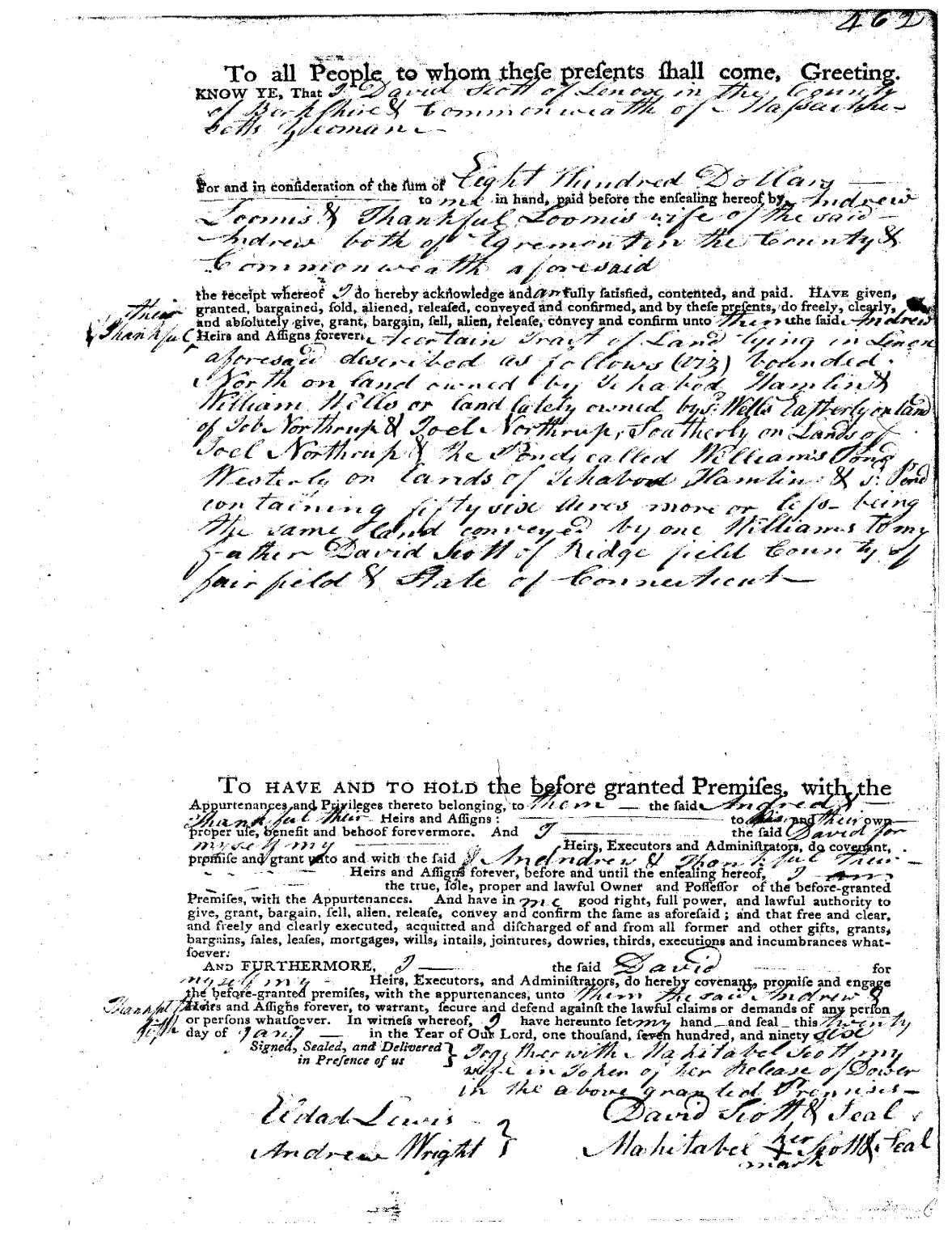
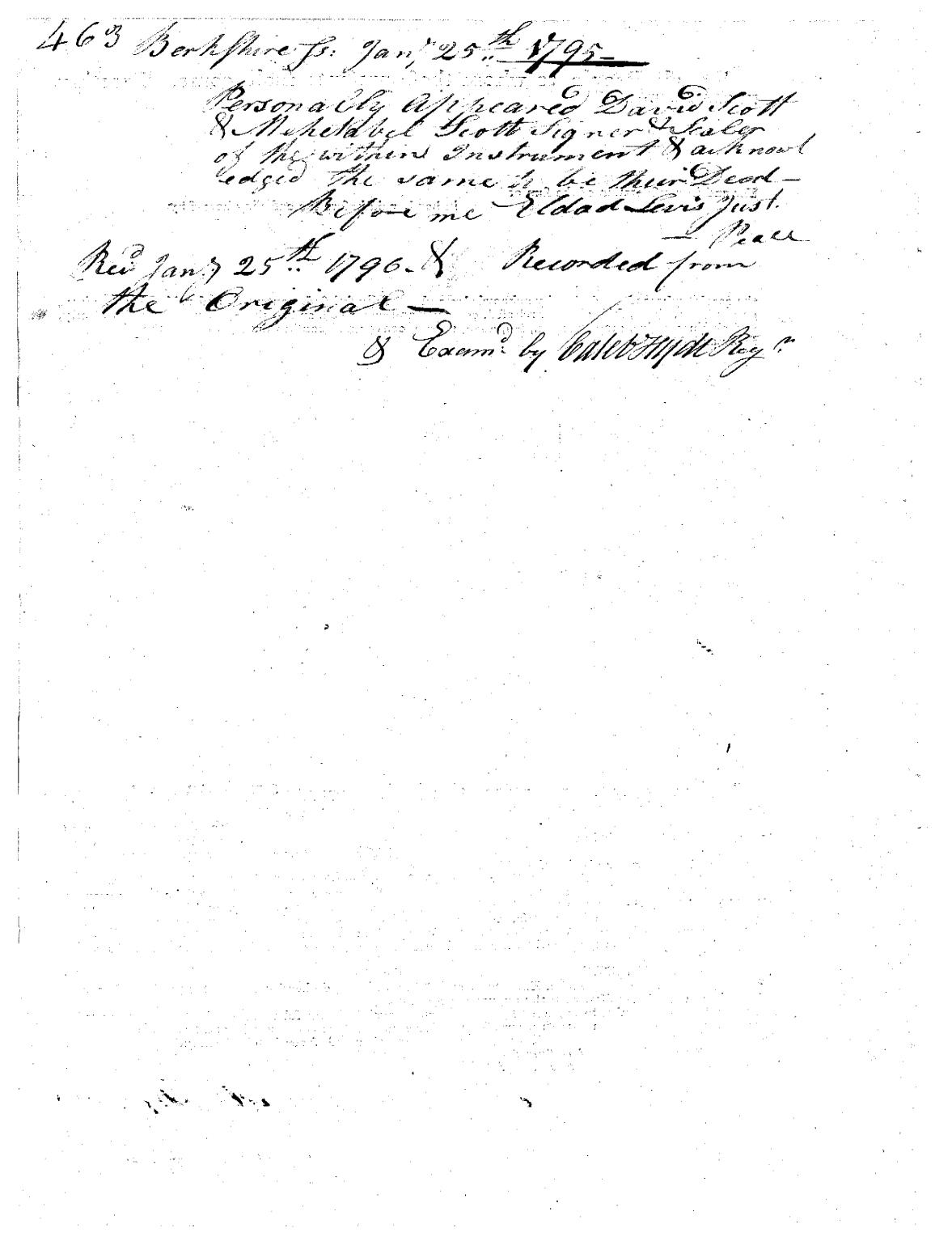
The sale names the wife of David of Lenox; the March 1806 Lowville will names David’s wife as Mehitabell. That agreement strengthens the identification of the Lenox and Lowville couples. The sale does not say the couple moved to Lowville. [6] [8]
The elder David’s 1809 estate
The Danbury Probate Court distribution, p. 206, records land set out “to the Heirs of David Scott deceased, Son of the said David deceased.” The preceding court entry also calls the son deceased, and pp. 206–207 describe three parcels allotted to his heirs as a group and credit an advancement from his father. The record names Hannah Scott as the elder David’s widow and includes a separate allotment to his son Gideon. [7]
This is direct evidence of the father–son relationship and of the son’s death before the 1809 distribution. It does not name his individual heirs, their residences, or the son’s place of death. Jacobus reports that the elder David’s will was written in 1802 and proved in 1809, and attributes the younger David’s move to New York’s Black River country to the family account, not to the estate record. Taken together with the recorded Lenox deeds and the 1806 Lowville will, the records strongly support identifying the deceased son with David of Lenox and Lowville. [2] [6] [7] [8]
- Loose estate file 4134: cover card. Connecticut State Library, Danbury Probate Files, David Scott of Ridgefield, 1809; FamilySearch image group 007626866, image 3207. The card lists a will, a bond, two inventories, a distribution, and an administration account.
- Recorded distribution, pp. 206–207 · pp. 208–209 · pp. 210–211. Danbury Probate Court, FamilySearch image group 007627317, images 113–115. These supplied PDFs include machine transcripts; read the handwritten images when wording matters. Page 211 continues into a different estate.
The family in Lenox and Lowville
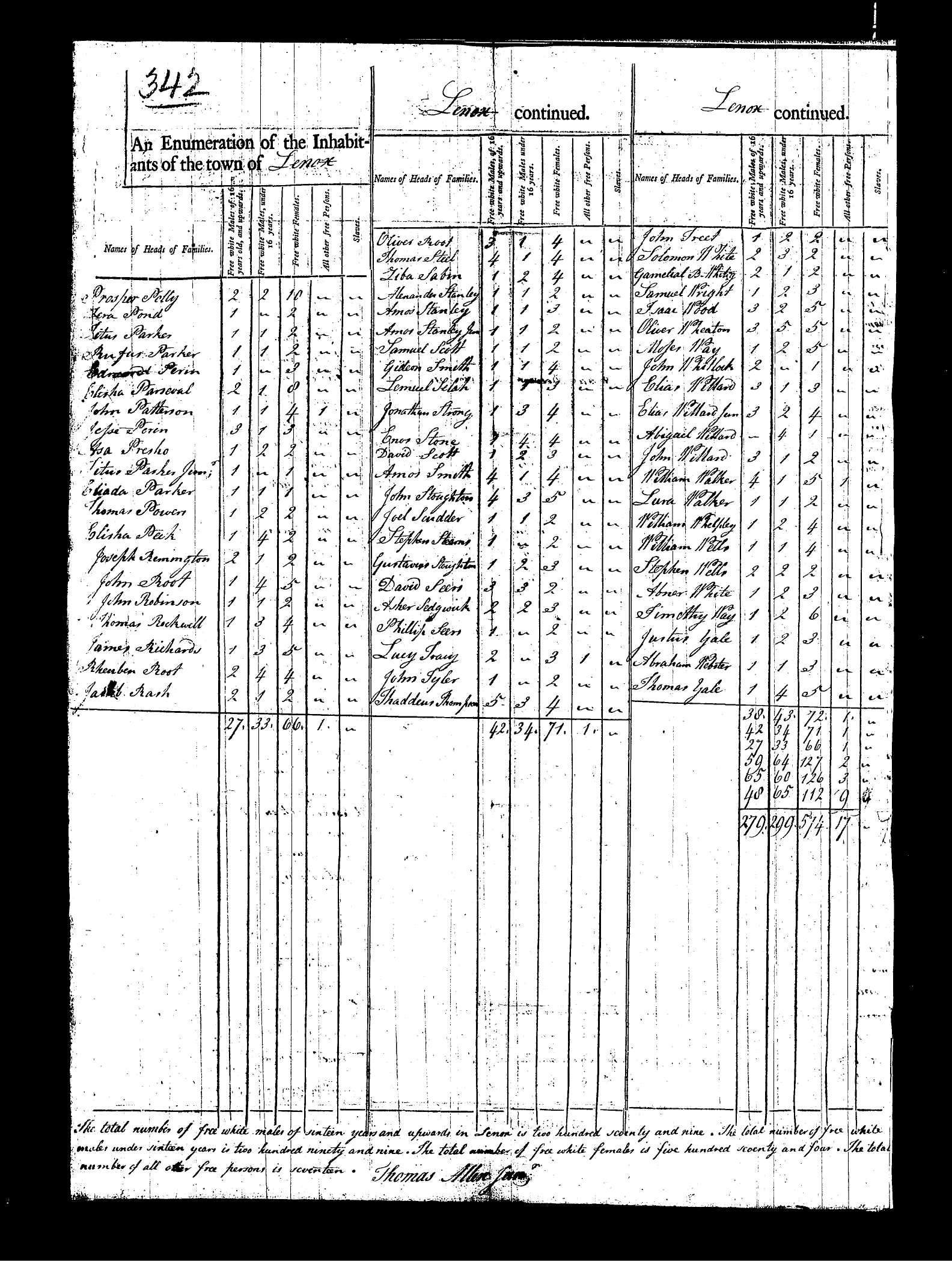
The 1790 federal census for Lenox names David Scott as a household head but does not name the other occupants. The Lenox church typescript records baptisms for Anna, Prudy, Josiah, and Jeremiah on June 7, 1795, and Betsey on July 3, 1796. These are baptism dates; the entries do not name Anna’s eventual husband. [6] [8]
The congregation at Stow’s Square
David Scott is named among the original members of the Congregational church at Stow’s Square, near Lowville, in W. R. Adams’s 1897 church history, reprinted in edited form in the 1997 First Presbyterian Church memorial book. Franklin B. Hough’s 1860 county history (p. 167) also lists David among the founding members and dates the organization by Rev. Ira Hart to December 3, 1803. The memorial-book copy shows December 4 with a handwritten correction that appears to change the year to 1803. The two accounts support David’s connection to the early congregation, but the exact day is unsettled without the original minutes. [4] [9]
David’s will of March 13, 1806 names his wife Mehitabell and his children, including a daughter Anna, without giving Anna’s married surname. William Scott’s June 28, 1857 letter (William’s biography), preserved here in a later transcription, supplies Bible dates for the family. William gives his father’s birth as June 2, 1752; Jacobus gives June 11. The legacy essay suggests two birth days may have been transposed, but the original letter and Bible have not been checked. [2] [8]
The 1806 Lowville estate inventory
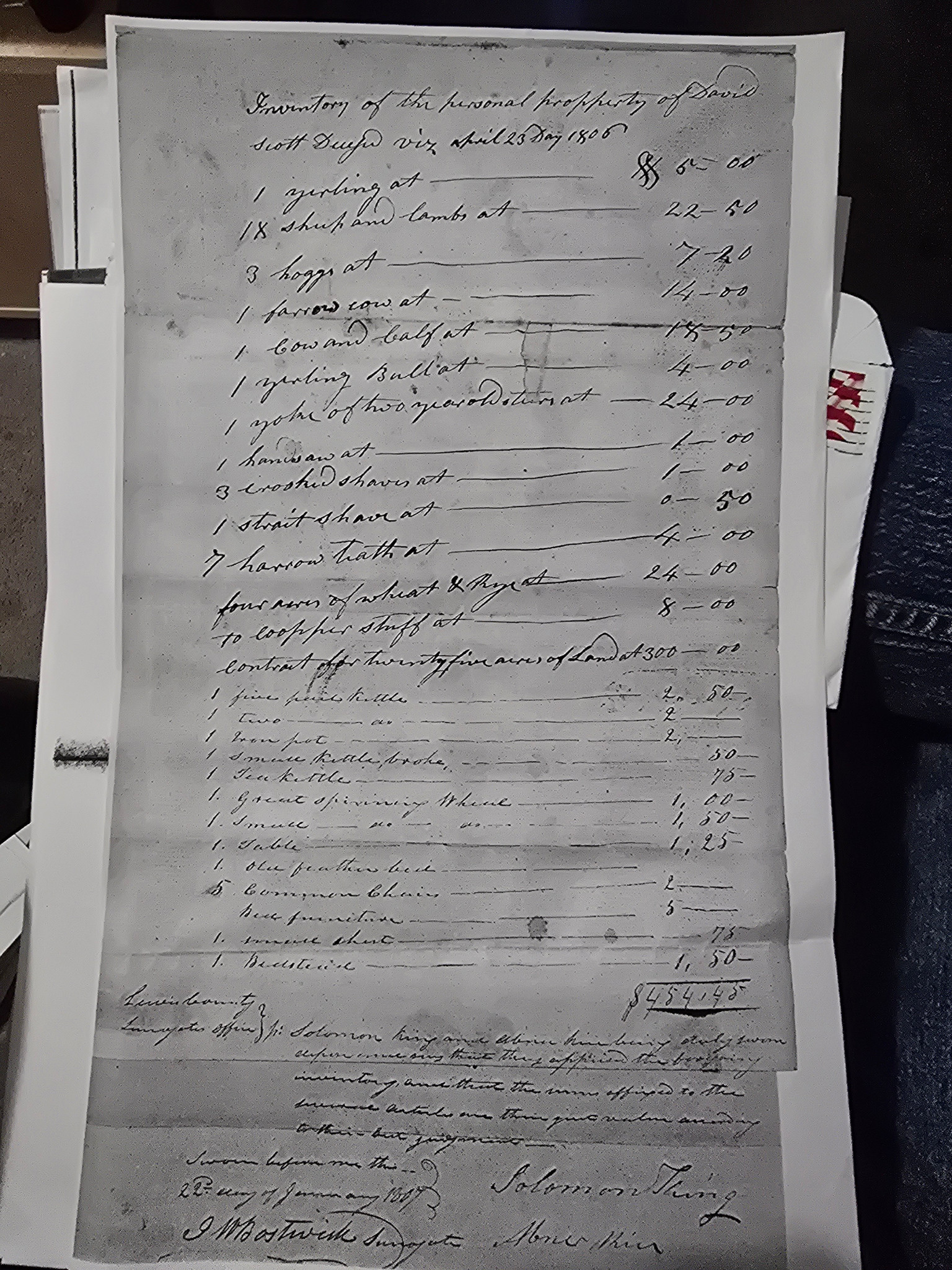
A Lewis County inventory dated April 23, 1806 lists a contract for 25 acres valued at $300, four acres of wheat and rye, sheep and lambs, cattle, woodworking tools, cooper’s supplies, and two spinning wheels. It describes the younger David’s household and working property. The land entry is for a contract, not a deed, and does not identify the tract. This is the New York estate of David of Lowville, distinct from his father’s 1809 Connecticut estate. [3]
What Enos’s records add
Read Enos Scott’s biography for his family, New York militia appointment, and later years in Michigan.
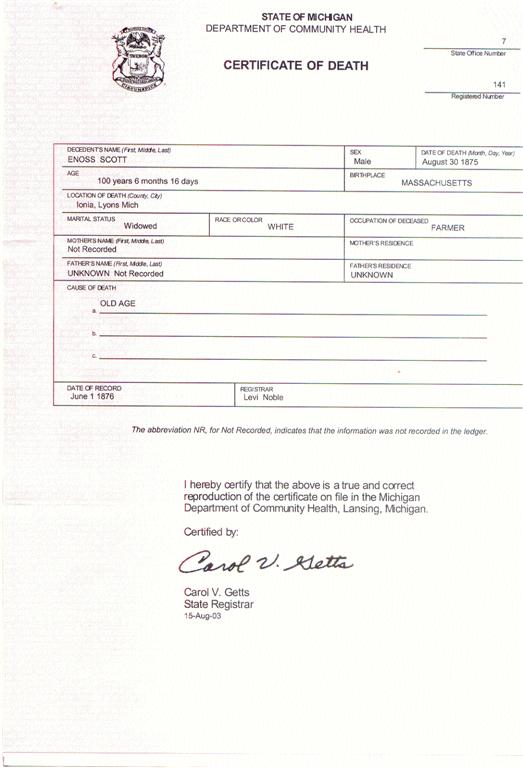
Enos Scott’s Portland Observer obituary names Lenox as his birthplace and describes years in Lewis and Jefferson Counties, New York, before his move to Michigan. It reports a funeral at B. F. Faxon’s home and mentions a sister near Lyons without naming her. A separate September 1875 notice says he farmed near Perch River for years. The Portland notice reports an August 28, 1875 death; the civil death return gives August 30. New York’s published Council of Appointment minutes list him as a militia captain in 1805. Enos’s reported kinship to Winfield Scott remains unverified. [10]
The Scott branch that led to Scottsdale
Read the biography of Winfield Scott (1837–1910), the Civil War captain and later Army chaplain for whom Scottsdale was named. The page traces his descent through Gideon Scott, David’s brother, and explains why he should not be confused with the general named in Enos’s obituary. [7] [10]
Sources and next checks
- David Scott source guide: will image, census scan, letter, and obituary.
- Donald Lines Jacobus, “The Scott Family of Ridgefield, Conn.,” The American Genealogist 44, no. 1 (January 1968), pp. 9–14. Publisher’s contents index; licensed full-text access for members.
- Lewis County, New York, Surrogate’s Office, inventory of David Scott’s personal property, April 23, 1806; family photograph supplied by Mark Webb.
- W. R. Adams, “History of the church 1797–1897,” presented July 11, 1897; edited reprint in Patricia Homer and Jane Thomas, eds., The First Presbyterian Church, Lowville, New York: One Hundred and Seventy-five Years, 1822–1997, Memorial Book (Black River Printing, 1997). Cover, title page, and excerpt supplied by Mark Webb.
- Carol Clark Johnson, Fullers Sissons and Scotts (American International, 1976), a published family history, not an independent substitute for the original records.
- Berkshire Middle District Registry of Deeds, books 11:113–114, 35:123–125 and 34:462–463; p. 462 and p. 463, images; later Lenox abstract and church typescript.
- Danbury Probate Court, 1809 recorded distribution, pp. 206–207; see the linked file cover and further images above.
- Federal census, Lenox, Massachusetts, 1790; Lewis County, New York, David Scott’s 1806 will; William Scott’s letter of June 28, 1857, later transcription.
- Franklin B. Hough, A History of Lewis County (1860), p. 167.
- Enos Scott, Portland Observer obituary; Watertown notice; civil death return; militia minutes and other sources.
The next checks are the loose packet’s administration account and inventory versos, the original 1786 Lenox deed, and Ridgefield deeds after 1809 for a sale by the younger David’s heirs. A deed or power of attorney naming the heirs and their residences could tie the Connecticut allotment directly to the New York family.