Scott family · Fine and the Adirondacks, New York
Philo “Fide” Scott
1837–1911
On Big Deer Pond, at the camp he called Lost Lake, Philo Scott took visitors into the Adirondack woods and waters he knew best. By the time he died in 1911, readers as far away as Boston knew him as “Uncle Fide.” For the Webb family, he is also a grandson of Enos Scott, Anna Scott Webb’s eldest brother. [1] [3] [7]
From near Watertown to Fine
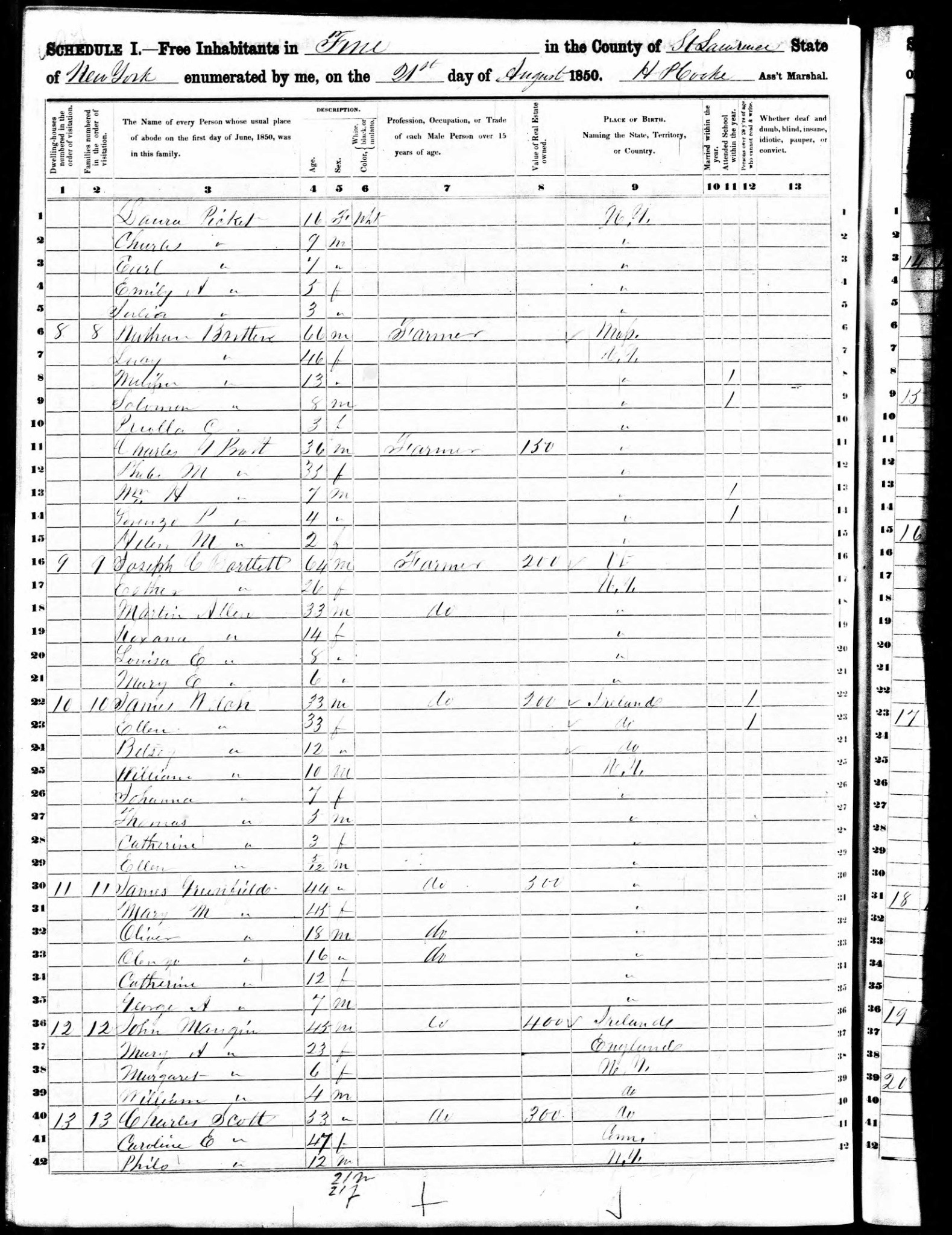
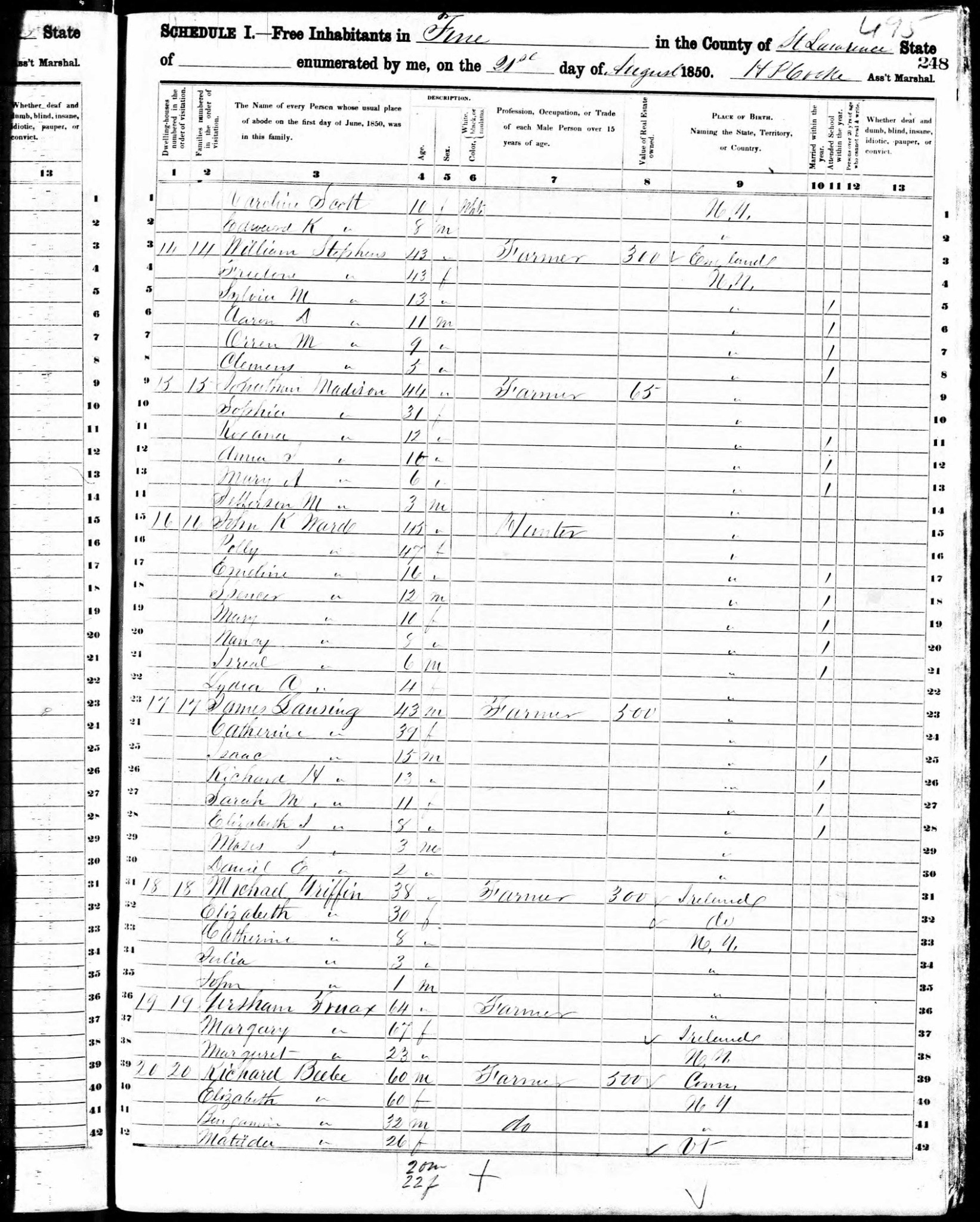
Family information identifies Philo as the son of Charles Augustus Scott and grandson of Enos. The St. Lawrence County Civil War database names his parents as Charles A. Scott and Caroline E. Weed. [12] The 1850 federal census in Fine lists Philo, age 12 and born in New York, in the household of farmer Charles Scott, 53, and Caroline E. Scott, 47. Their household continues onto the next page with Caroline Scott and Edward K. Scott. The census shows who lived together, but it does not state their relationships. Philo is not Philo C. Scott, the son named in William Scott’s will. [2]
The Boston Evening Transcript places Philo’s birth at the family home near Watertown and says his parents moved into the North Woods when he was a boy. Christopher Angus gives the birthplace more specifically as Brownville, Jefferson County; the county historical association’s compilation gives April 28, 1837, in Limerick, a hamlet in Brownville. [12] The family reunion sheet identifies his wife as Cordelia Stevens Scott (1837–1904) and gives their marriage year as 1856. The county compilation gives August 17, 1856, while Don Williams gives 1857. The original marriage record has not been checked. [12] The sheet also distinguishes their log home in Fine, on the south side of the Oswegatchie, from Philo’s backcountry camp. [1] [3] [4] [5]
Civil War service
The New York adjutant general’s roster records that Scott enlisted at Ogdensburg on September 12, 1861, and mustered in on October 30 as a private in Company D, 60th New York Infantry. The roster records him as having deserted from Harpers Ferry on December 10, 1862. Later accounts differ on the length and circumstances of his service. St. Lawrence University holds a file with pension records, correspondence, and notes that may help resolve those differences. [10] [11] [12]
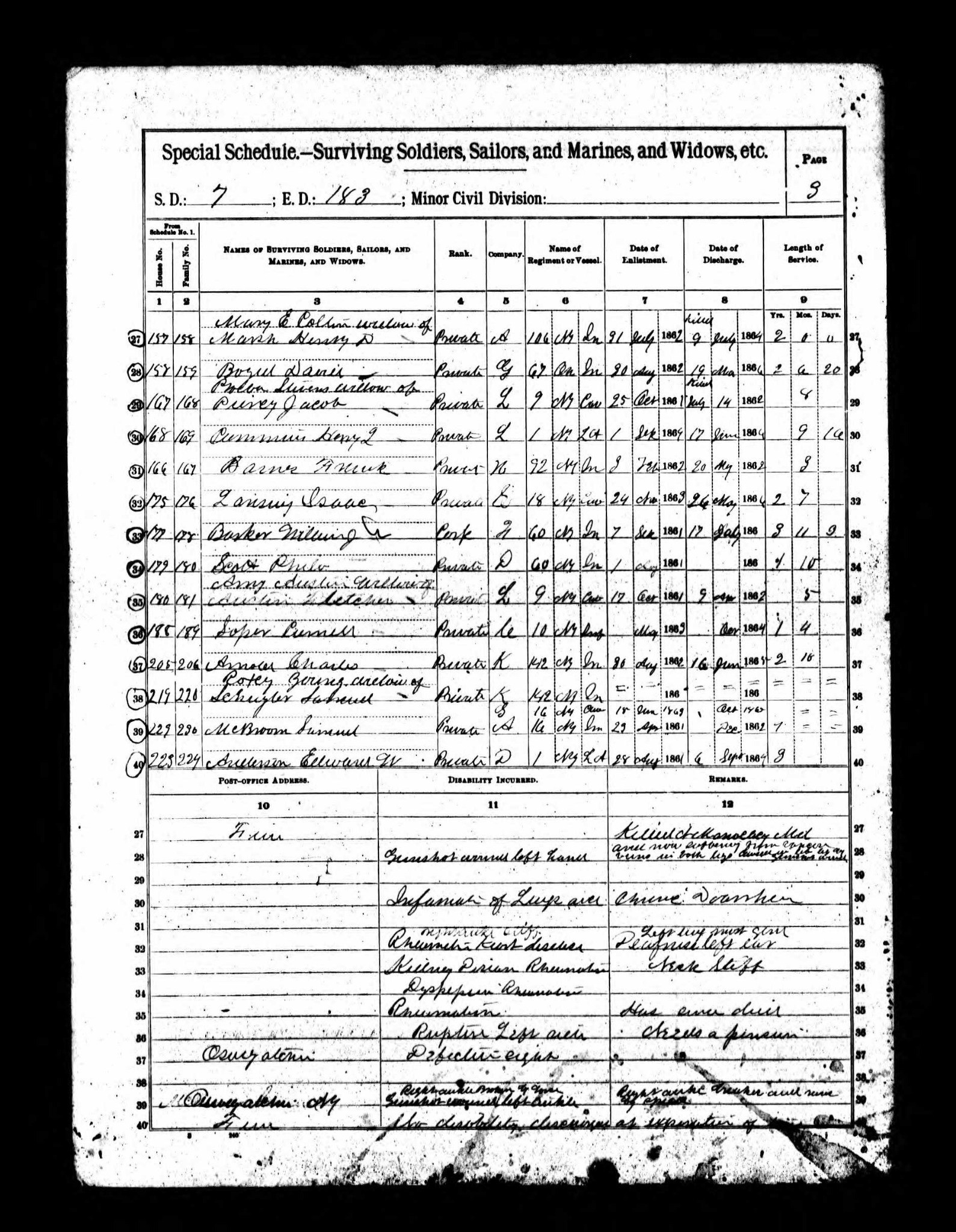
The 1890 veterans schedule also lists Scott as a private in Company D, 60th New York Infantry. It gives August 1, 1861, as his enlistment date, records one year and ten months of service, and leaves the discharge date unfilled. Those details differ from the state roster. The later census entry confirms the unit but does not establish when or how his service ended. [11] [19]
Guiding from Lost Lake
New York’s Department of Environmental Conservation identifies Big Deer Pond as the site of Philo’s camp and dates his work there to roughly 1866–1906. Angus reports that Philo called the pond Lost Lake and charged visitors $1 a day for board and $3 a day for guiding. Fowler’s later essay describes a clearing with a cabin and outbuildings, where some hunting and fishing parties brought their own provisions. Fowler explicitly warns that these were campfire stories he had heard in different versions. [4] [6] [7]
Scott left a woods story in his own name. In an 1888 letter to Forest and Stream, he recalled working with Stephen Ward and catching a panther in June 1861 at Toad Hole, on the carry between Grass Pond and Mud Lake. It is a recollection published nearly three decades after the event. A separate Gouverneur-area news clipping, annotated November 1875, reports that he returned from the woods with a story of a close encounter with a black bear. The supplied clipping does not show the issue date or page. [8] [13]
A cow named Betsy and a dog named Christmas
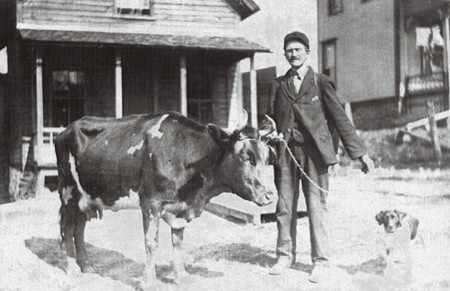
Adirondack guide Herbert F. Keith remembered Scott coming to Wanakena for supplies with his animals. Betsy, his cow, carried the load back to camp. The St. Lawrence County Historical Association identifies Betsy and Scott’s dog Christmas in a photograph it says was sold as a postcard at Wanakena’s Rich and Andrews General Store. [15]
From the trail to print and Albany
One of Philo’s longtime clients was the novelist Irving Bacheller. Bacheller gave Philo a voice in his comic Adirondack poem “Him an’ Me,” first published in Harper’s Weekly in December 1904. A period newspaper account reprinted by the St. Lawrence County Historical Association describes Bacheller reading the poem aloud at Benson Mines and presenting Scott with a framed copy. Philo also helped inspire the woodsman in Bacheller’s 1906 novel Silas Strong, Emperor of the Woods; the novel is fiction, not a record of Scott’s life. [5] [7] [9]
In his 1938 memoir, Bacheller remembered Philo and Cordelia reopening the camp each summer. They aired the bedding, and Philo cleaned the stove, mended what winter had left in disrepair, and planted his garden. Bacheller also remembered a horn calling guests to breakfast just after daylight, with griddlecakes and maple syrup on the table. He studied Philo’s speech and used it to shape his characters’ dialogue. His memoir’s “Zig Zag Story” starts with a bear in a trap and wanders from a capsized canoe to a man on the railroad tracks. A 1959 Tupper Lake Free Press clipping preserves a variant with the same digressions. These are examples of the way the story was told and retold, not independent confirmation of the events. [14] [16]
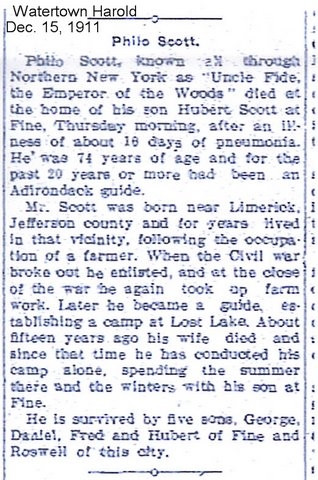
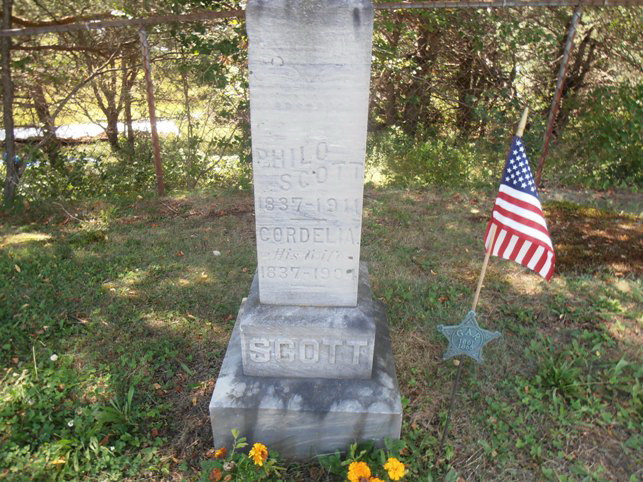
Angus recounts that Scott went to Albany to advocate for hunting and fishing licenses. The Transcript reports that he was invited onto the New York Senate floor as Horace White’s guest and asked to speak, an occasion Scott told friends was his proudest. The newspaper reported that Scott died on December 14, 1911, aged 74, after an illness of several weeks. The local obituary adds that he died of pneumonia at his son Hubert’s home in Fine. It names five sons who survived him: George, Daniel, Fred, and Hubert of Fine, and Roswell of Watertown. The county compilation places his burial in Woodland Cemetery in Fine; the shared marker gives 1837–1911 for Philo and 1837–1904 for Cordelia. [17] [18] [3] [4] [12]
The Scott family reunion photographs
This sheet was compiled for the July 30, 2005 Scott family reunion. The captions on the reverse are mirrored relative to the front; the list below follows the photos as you see them. Dates and identifications are from the family captions. [1]
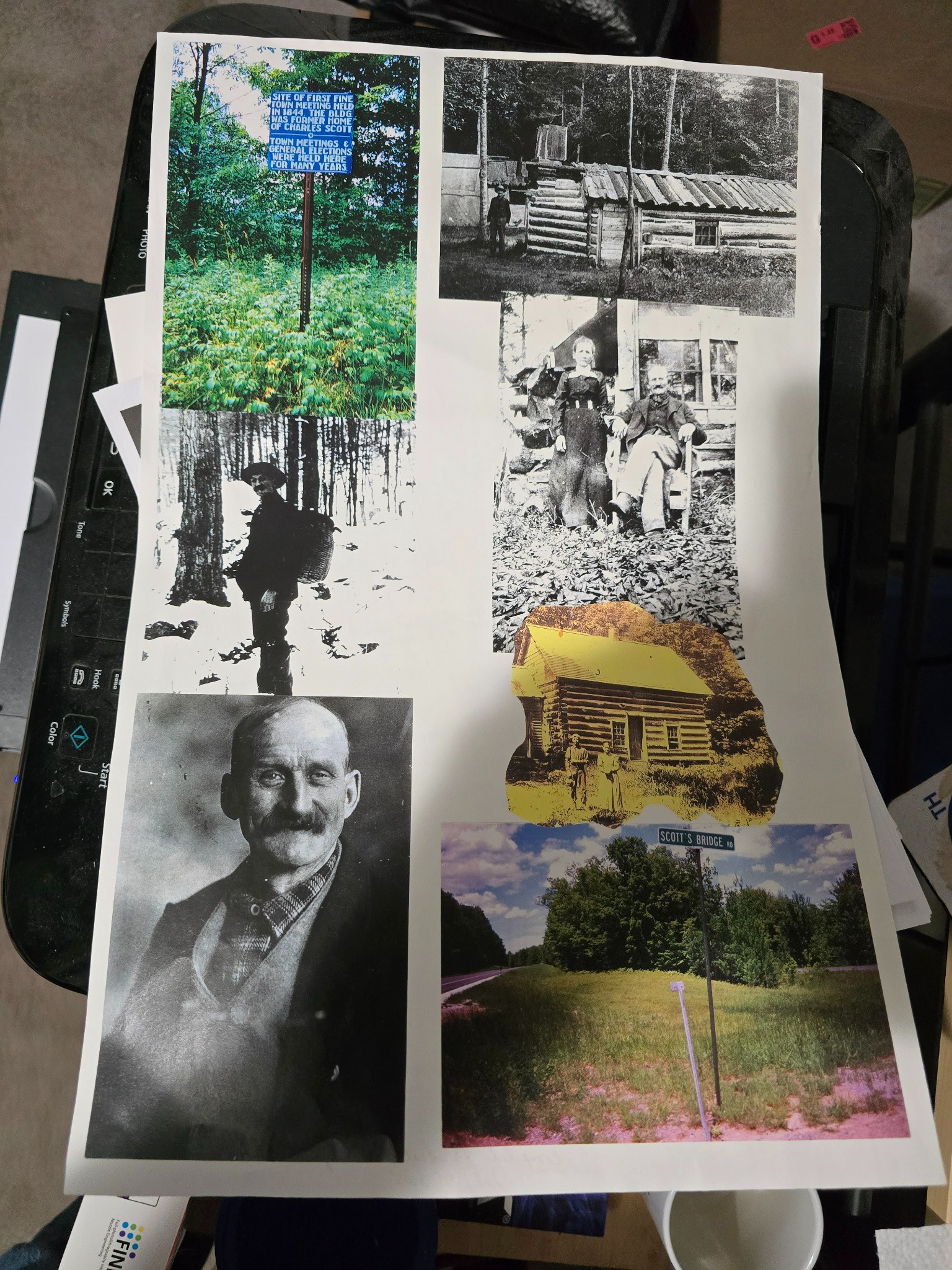
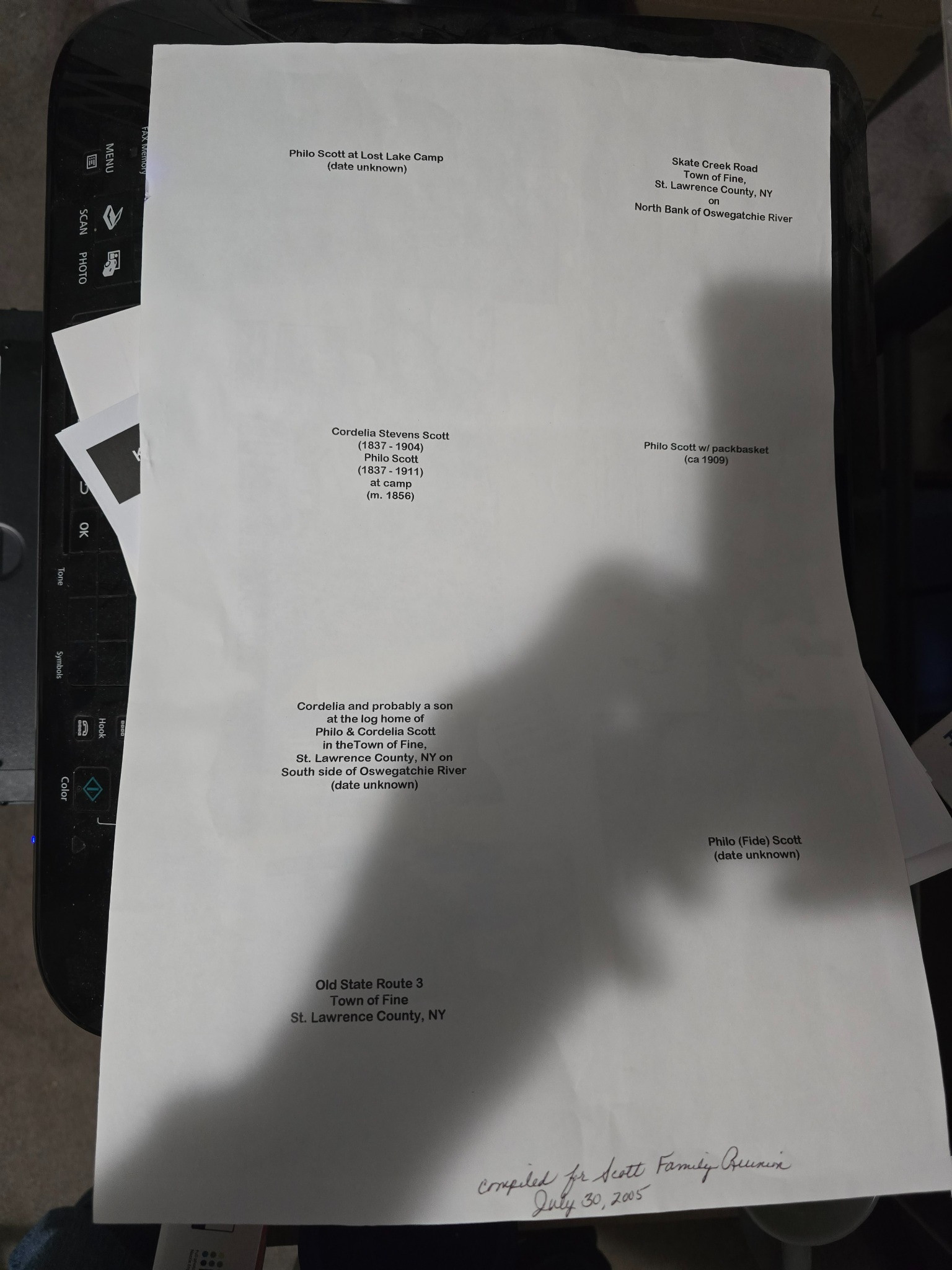
- Top left: The historical marker at Skate Creek Road, on the north bank of the Oswegatchie, identifies the site of Charles Scott’s former home and notes that town meetings and elections were held there.
- Top right: Philo at Lost Lake Camp, undated.
- Middle left: Philo in the woods with a packbasket, about 1909.
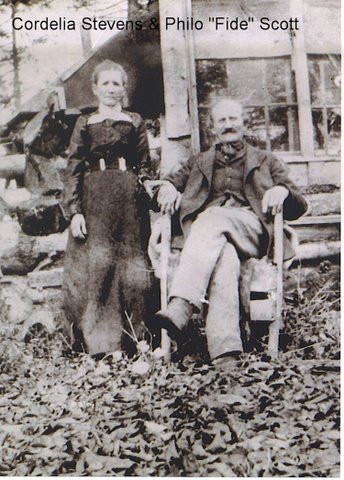
- Middle right: Cordelia and Philo at camp.
- Sepia image on the right: Cordelia and a person the caption tentatively identifies as a son, at the Scotts’ log home in Fine.
- Bottom left: Philo’s portrait, undated.
- Bottom right: The Scott’s Bridge Road sign along old State Route 3 in Fine.
Sources and record images
- Scott family reunion photo sheet, July 30, 2005, front and captioned reverse; family identification of descent from Enos, supplied by Mark Webb.
- 1850 U.S. census, Fine, St. Lawrence County, New York, August 21, dwelling and family 13, FamilySearch DGS 004203142 (FHL film 444305), image 502, lines 40–42, and image 503, printed p. 248, lines 1–2.
- “An Old Adirondack Guide,” Boston Evening Transcript, December 15, 1911, p. 5.
- Christopher Angus, “An Oswegatchie Odyssey,” illustrated by Jennifer Thermes, Adirondack Life, March/April 1999, pp. 48–53, 86; Scott on pp. 49 and 51.
- Don Williams, “Scott was a true Adirondack guide,” The Leader-Herald (Gloversville, New York), “Inside the Blue Line,” March 21, 2004 (date on supplied clipping); accompanying family-annotated Adirondack map.
- Albert V. Fowler, “The Hermit of Big Deer,” The Adirondack Mountain Club Annual, pp. 25–32; year not visible on the supplied excerpt.
- New York State Department of Environmental Conservation, Five Ponds Wilderness Unit Management Plan, printed p. 4, chronology; p. 71, bibliography.
- Philo Scott, letter published in Forest and Stream, June 14, 1888, p. 412, Smithsonian Libraries and Archives digital copy.
- Irving Bacheller, “Him an’ Me,” Harper’s Weekly, December 10, 1904, later collected in In Various Moods; “A Reading at Benson Mines,” reprinted with the poem under the heading “Dedication” in the St. Lawrence County Historical Association Quarterly, October 1974, pp. 8–9.
- St. Lawrence University Libraries, Cranberry Lake Collection, MSS 31, box 1, folder 2, finding aid for Philo Scott pension records, correspondence, and notes. The finding aid describes the holdings; no pension file is transcribed here.
- New York Adjutant-General, Sixtieth Infantry roster, “Scott, Philo,” printed p. 794.
- St. Lawrence County Center for History and Culture, Civil War Database, “Scott, Philo”, compiled from service, census, newspaper, and cemetery sources.
- Gouverneur-area newspaper clipping on Philo Scott’s encounter with a black bear, annotated November 1875; exact issue and page unverified. Supplied by Mark Webb.
- Irving Bacheller, “Great Scott: The Storyteller of Lost Lake,” in From Stores of Memory (New York and Toronto: Farrar & Rinehart, 1938), chapter 13, pp. 127–133; supplied scan.
- “Cover Photo” and Herbert F. Keith, “The Old Guides of the Oswegatchie River,” St. Lawrence County Historical Association Quarterly, vol. 17, no. 2 (April 1972); cover identification, postcard provenance, and Keith’s account of the supply trips, pp. 3–4.
- Tupper Lake Free Press, column excerpt with a variant of the “Zig Zag Story”; supplied clipping labeled “Our Man About Town” and dated 1959. Exact issue and page are not visible in the excerpt.
- “Philo Scott,” local death notice, supplied clipping annotated Watertown Herald, December 15, 1911. The original issue and page have not been verified.
- Separate copy of the portrait of Cordelia and Philo at camp and photograph of their shared Scott marker, supplied by Mark Webb.
- 1890 U.S. census, special schedule of surviving Union veterans and widows, St. Lawrence County, New York, SD 7, ED 183, p. 3, line 34, dwelling 179/family 180; National Archives microfilm publication M123, roll 52, scan 653. Image supplied by Mark Webb.