Isaac Webb & Emeline Cone
The family history places their 1828 marriage in Painesville, Ohio, and traces Isaac in the Perry censuses. The Old Webb Bible transcription also preserves a marriage entry, marked as difficult to read.
New York · Ohio · Wisconsin
A family history told through the photographs, Bibles, wills and census pages that survived. Start with James and Anna in New York, then follow the records to Ohio and the next generation.
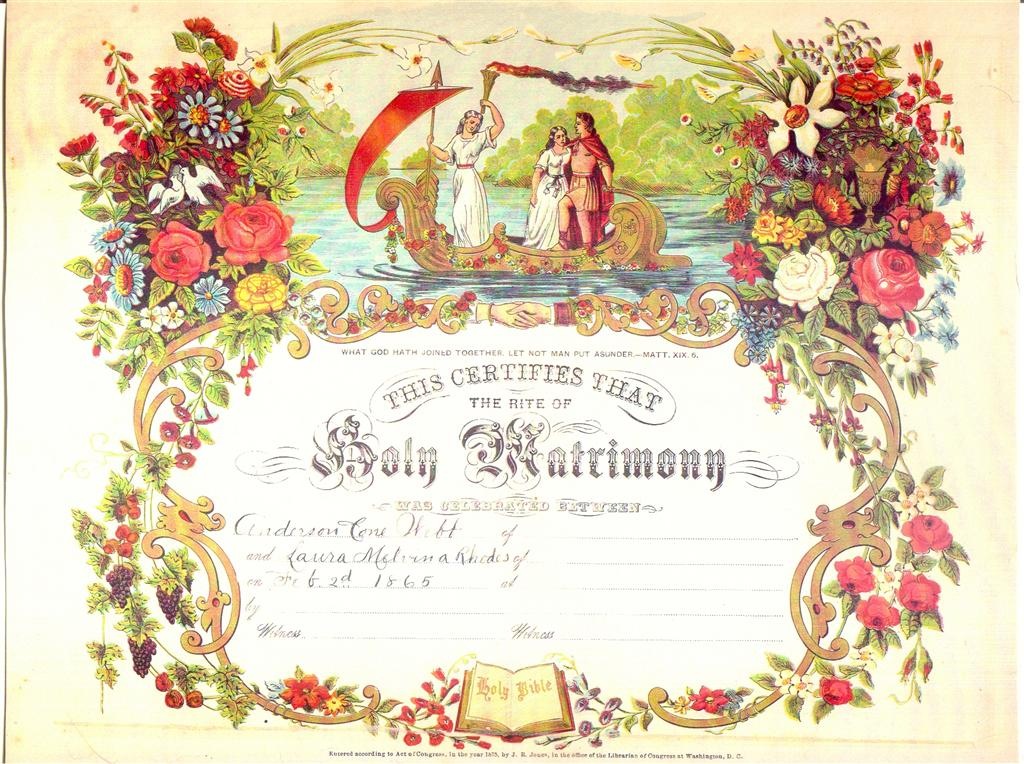
Family story
Start with James and Anna, then explore the branches that can help identify earlier generations. Not every proposed child is equally well documented. How this Archive Began.
A later transcription of the Lenox records lists Anna and four siblings among David Scott’s children. It documents their baptisms in Massachusetts, not a marriage or a connection to James Webb in Lenox.
David Scott’s will in Lowville names Anna among his daughters and leaves her one dollar. It gives no married surname, so it cannot by itself identify her as Anna Webb.
The census lists a James Webb in Westmoreland, Oneida County, in both years. These returns name the head, not the rest of the household. The two pages are best read side by side.
In 1849, Anna swore in Lake County that James was her husband and Charles’s father. She placed James’s death in Mayfield, Ohio, about February 6, 1835. Her statement is a direct family account, given fourteen years after the event.
William Scott passed down Bible dates in a letter to his nephew Isaac Webb. A separate Webb Bible transcription reports Anna’s death as April 15, 1865, but marks the entry as hard to read.
The family history places their 1828 marriage in Painesville, Ohio, and traces Isaac in the Perry censuses. The Old Webb Bible transcription also preserves a marriage entry, marked as difficult to read.
Read David’s biography, from Cazenovia and Akron to Michigan, Kansas, and Illinois. David and Julia married in 1833. Their son Anderson’s family Bible and portraits bring the Michigan branch into view. Julia’s death certificate records her final years in Illinois. Read how their grandson Frank Jay Webb grew asparagus near Paw Paw, or follow Anderson’s brother Milo Cone Webb from Kansas to Arizona.
Read William’s biography, from Oneida County through Ohio to the Wisconsin farm and Albany village. The family Bible is associated with Albany in Green County. The family photographs include William and his daughter Jane Ann Webb Brown.
People & stories
Browse biographies and family stories by branch. Each profile links to the records behind the story. Icon Library.
Isaac and Emeline Cone made their home in Perry, Ohio, where deeds and census records distinguish him from his New York namesakes.
A moulder, farm laborer, and merchant whose family lived in Ohio, Michigan, Kansas, and Illinois.
From New York and Ohio to his Wisconsin farm, with Fanny Rice’s Bible and the sources that name his parents.


A tide waiter before enlisting, his Mexican–American War service, and the bounty-land records that name his parents.

A Wisconsin livery operator and veterinary practitioner whose daughter remembered him holding court at home.
Robert Webb’s daughter kept his family Bible and told Wilford J. Webb how her father held court at home.
Cora Webb Barto’s son directed orchestras while studying law, then practiced in Wisconsin and Minnesota.
Sarah “Sally” Webb’s son went from a Paw Paw clerk to a Michigan Central railroad roadmaster.
David and Julia Webb’s eldest daughter built a life in Rockford after marrying Lorenzo Shannon in Ohio. Her estate records bring her sister Carrie back into the story.
David and Julia’s son moved from Akron to Paw Paw, where the family Bible and portraits document his life with Laura Rhodes.
David Webb and Julia Cone’s son, from Civil War letters to Arizona ranching.
A newspaper, a merchant family in early Sedan, and Carrie’s later years in Illinois and California.
William Webb’s daughter attended Milton College in Wisconsin. Her scrapbook and memorial card help tell her story.
Anderson Cone Webb and Laura Rhodes’s son, a Paw Paw asparagus grower.
Carrie Webb Turner’s daughter married in Rockford and later joined a hiking club gathering in Glendale, California.
Isaac Webb’s great-grandson, an Ohio accountant who traced the Perry and Wisconsin branches and tested the family’s account of James Webb’s ancestry.

Isaac Webb’s great-granddaughters taught folk dance and mathematics in Iowa. Loretta also helped preserve the Van Ness family record.
Frank Webb and Bertha Woodman’s son, from Paw Paw to the farms near Yardley.
From the Paw Paw farm to Port Huron’s study circles, the New York YMCA, and Gwynedd.
William Webb’s grandson bought horses for Ringling Bros. Circus and cattle for shipment to Mexico.
William Webb’s great-grandson, from an Iowa farm childhood to training Michigan driver-education teachers.
Anderson Cone Webb’s grandson and co-founder of the Houston Youth Symphony.
Edwin Webb and Alice Wigginton’s son, in his own wartime recollections and in family accounts of his life.
A U.S. Army veteran from Paw Paw who taught at USF and helped bring speech and hearing services to deaf children in Tampa.

Polly Webb’s great-grandson and an Army field nurse kept up a wartime courtship across two oceans before making their home in Wisconsin.
Polly Webb’s great-grandson served in naval aviation in World War I and led the science department at Crystal Falls High School.
Anna Webb’s grandson, a Lafayette lawyer whose son’s guardianship brought the Chase and Fowler families into court.
Anna Webb’s granddaughter, a pianist and early Wellesley student who helped found a Lafayette women’s study club before moving west.
Civil War service under two surname spellings, and the gas explosion that led to a congressional pension increase.
A Michigan bindery manager, Knight Templar, and Paw Paw dairy farmer.
The Pittsburgh records that connect the Stockdale, Wigginton, and Webb families.
A Pittsburgh-born stenographer who married Edwin Webb in Paw Paw and spent her later years in Orlando.
Father of David of Lowville and grandfather of Anna Scott Webb. The family identifies him as a Revolutionary patriot, but the service records do not yet distinguish father from son.
Anna Scott Webb’s father and the records connecting Lenox, Lowville, and Ridgefield.
Anna Scott Webb’s eldest brother was a cooper and farmer who lived to 100. His records trace the family from Lenox to northern New York and Michigan.
Anna’s brother, a Henderson farmer who preserved the Scott family Bible dates in an 1857 letter. His will identifies the next generation.
Anna’s first cousin, a newspaper publisher and inventor of a cemetery plotting stake.
, Army chaplainA Civil War captain and later Army chaplain who became the namesake of Scottsdale, Arizona.
Enos Scott’s grandson, an Adirondack guide whose Lost Lake camp and friendship with Irving Bacheller became part of North Country lore.
Grandson of Anna’s brother William, professor of international law, and fifth Law Librarian of Congress.
An original proprietor of Haddam, documented in 1657 and believed to be the immigrant ancestor of this Cone branch.
and his familyHaddam’s town militia in 1675, his will, and two paths into the Cone line.

A Connecticut Light Horse patriot named in the 1779 service return. See the family’s grave-marking ceremony.
Revolutionary War private of East Haddam, father of Anna Anderson, with his account of service and pension papers.
From East Haddam to Painesville, with the 1850 will that names his daughters Julia Anna Webb, Emeline Webb, and Sophia Cone Vesey.
The fall 1835 wagon journey to Michigan and five generations in a Woodman reunion portrait.
Michigan House Speaker, National Grange Master, and host of the 1877 five-generation Woodman reunion.
Three Mile Lake farmer, California Gold Rush letter writer, and 1880 Michigan candidate for governor.
Edson’s sister, from Paw Paw to a celebrated Bakersfield garden.
Paw Paw’s “Old Spud,” a potato grower, state senator, and pioneer of Michigan’s agricultural extension service.

Bertha’s father, from his Civil War letters to Chestnut Hill Farm in Paw Paw.
She helped build the Paw Paw asparagus farm and insisted on keeping it in the family.
Bertha’s sister, an Arthur Hill teacher who studied at Oxford and served on Saginaw’s AAUW board.
A Newtown tavernkeeper and militia officer whose will names Mary Hall and her children.
An 1828 coverlet, Fairfax County land, and the will that names Mary Melissa Hall.
A courtship in verse, a family’s move to Iowa, and the will that names Ella Grace Woodman.
A family sea captain and the records of a possible match in Revolutionary-era Rhode Island.
Rhode Island native and Paw Paw mason who worked on Van Buren County’s first courthouse.
Henry Rhodes and Demaris Parker, Henry W. Rhodes and Laura Luce, and their daughter Laura, who married Anderson Cone Webb.
A flour boat on the Paw Paw River and a Luce connection at Wildey Cemetery.
Family collection
Open a document image for a closer look. Captions say whether you’re seeing a record image, a later transcription, or a family account.
Places & journeys
Follow James Webb and Anna Scott’s family from New York to Ohio, then trace the next generation. Select any map to open the full-size image.
How to read the maps: A place can mark a household, a reported birthplace, or a single event. Lines show plausible routes using roads and waterways of the period, not a documented family itinerary. Proposed relatives and places that still need evidence are labeled.
Massachusetts & central New York
The two panels separate David Scott’s possible journey from Lenox to Lowville from the search for James Webb in central New York. Utica is shown as a possible gateway into the Black River country, not a documented Scott stop. The Erie Canal provides later geographic context; it is not part of the Scott journey.
The 1810 Manlius and 1800 Norway households are candidates, not confirmed sightings of our James. Isaac’s reported Montgomery County birthplace does not place the family in Florida township. David’s reported 1811 birthplace is Cazenovia; William’s reported 1819 birthplace of Utica may refer to the surrounding area. The Westmoreland census entries in 1820 and 1830 are the firm New York anchors.
Related evidence: Lenox church records · Evidence register
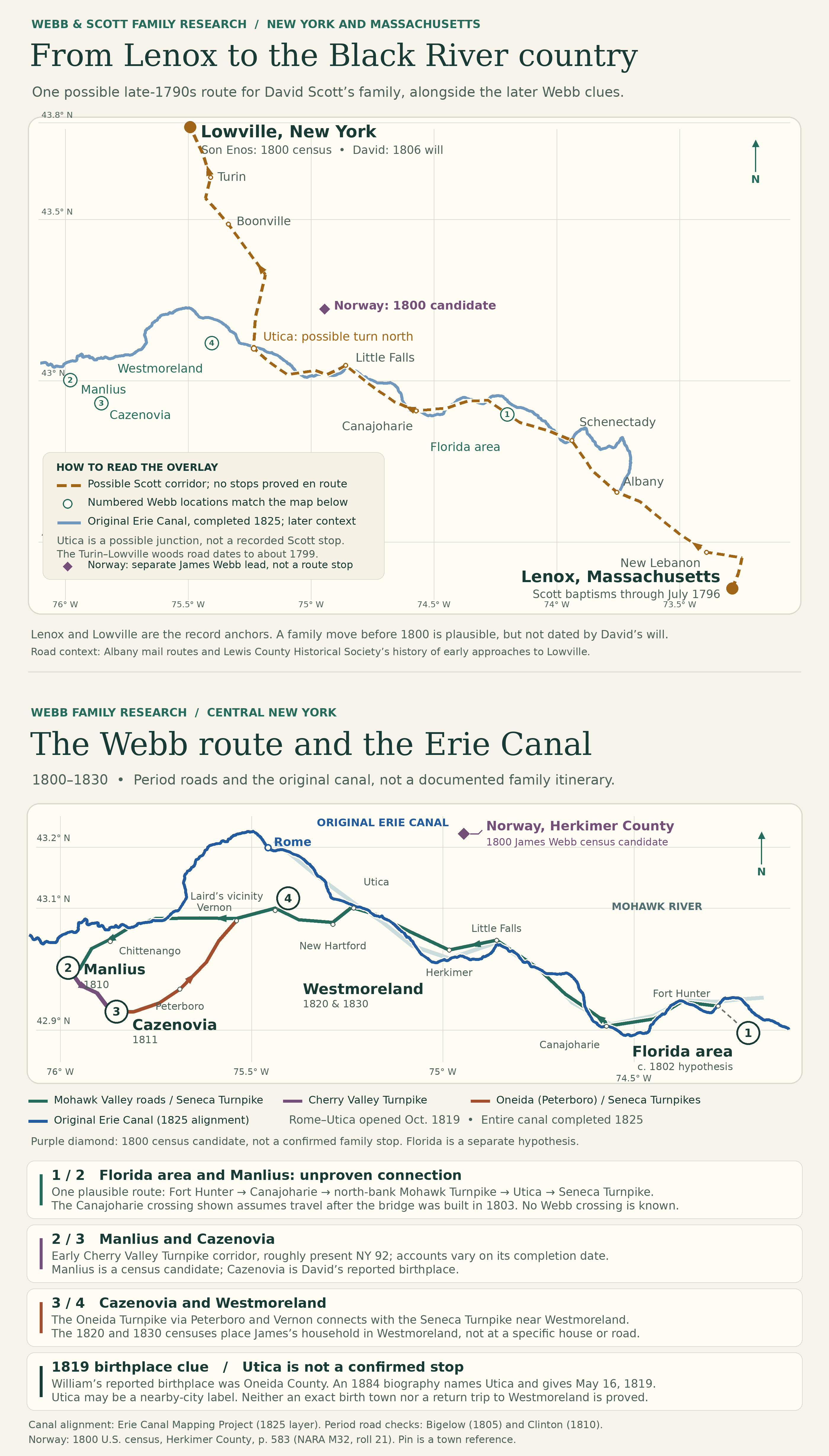
Norway and Manlius show where men named James Webb were recorded, not a route taken by one man. Follow the Westmoreland entries as the stronger New York anchors. Compare the Norway and Manlius census images and household counts.
New York to northeastern Ohio
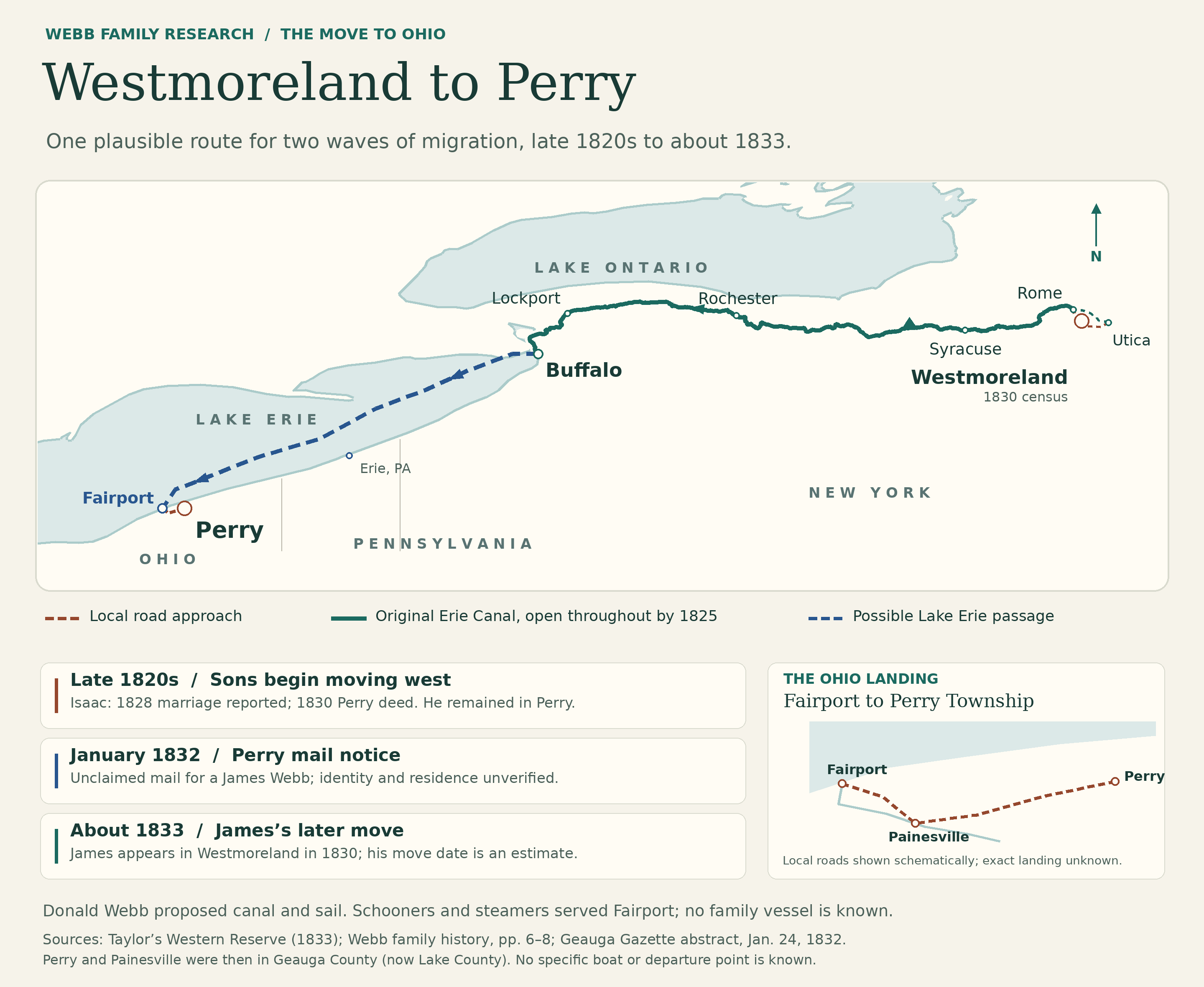
Some sons may have gone west in the late 1820s. Isaac’s March 1830 Perry deed places him there before James’s estimated move around 1833. Isaac stayed in Perry and died there in 1875.
Reaching the Erie Canal at Rome or Utica, taking a boat to Buffalo, and crossing Lake Erie to Fairport gives one plausible route. It does not establish how anyone traveled. An unclaimed letter for a James Webb at Perry in January 1832 is a lead, not proof that it was this James or that he already lived there.
Key record: Geauga County deed book 13, p. 343 (Isaac Webb, March 31, 1830).
Ohio, Michigan, Kansas & Illinois
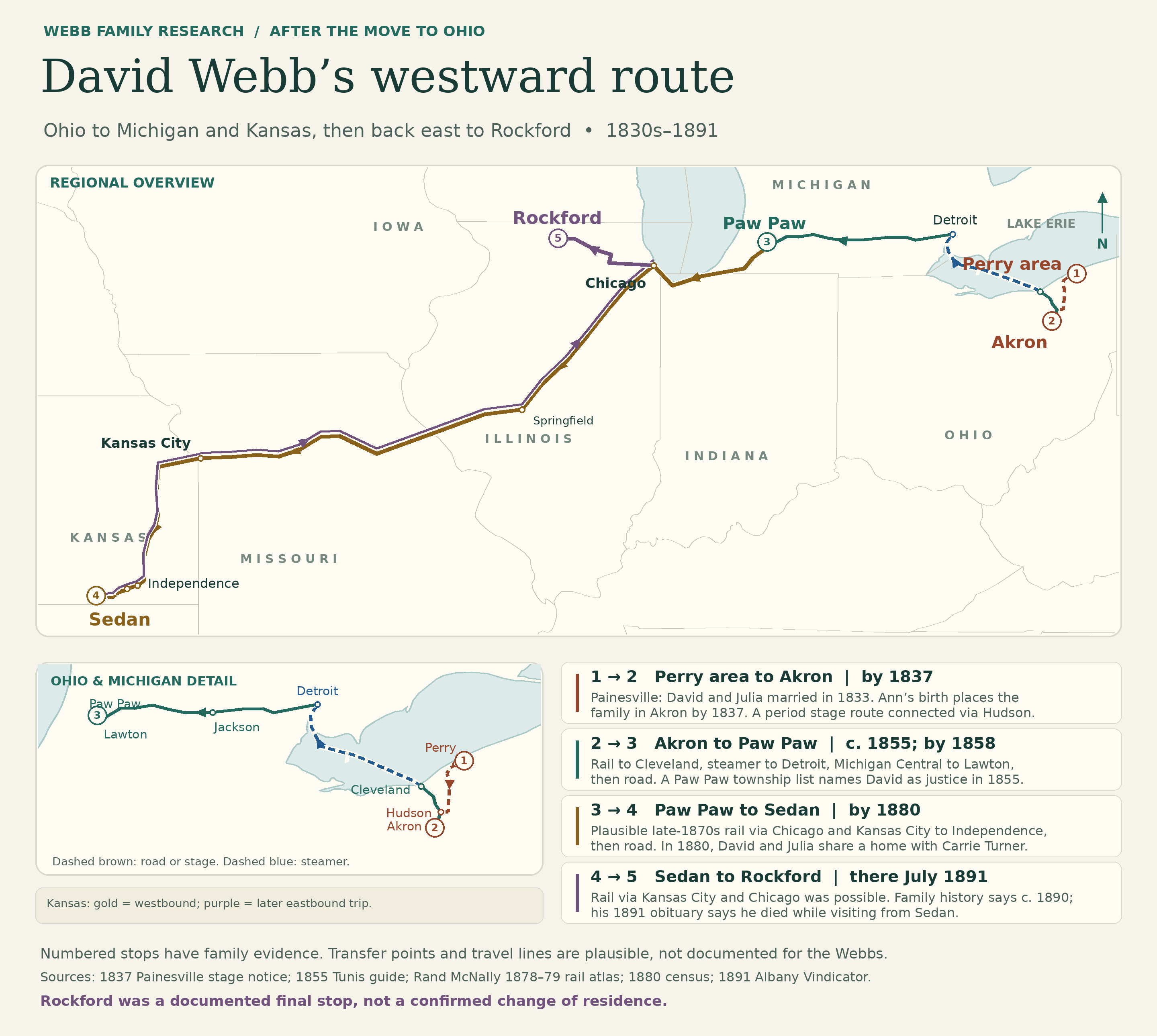
David’s route follows his 1833 marriage in Painesville, daughter Ann’s reported 1837 birth in Akron, the family’s presence in Paw Paw by 1858, and the 1880 household in Sedan, Kansas. The roads, boats and rail lines show how the journeys could have been made.
David died in Rockford on July 6, 1891. Rockford is marked as the death place, not a settled residence: the Albany notice describes a visit from Sedan, while his death certificate reports fourteen months in Illinois and a Rockford notice describes him living with his daughter.
Key sources: 1880 U.S. census, Sedan, household 230; Albany Vindicator, July 16, 1891. Read David’s biography or see Milo’s profile for the Sedan store notices.
Wisconsin
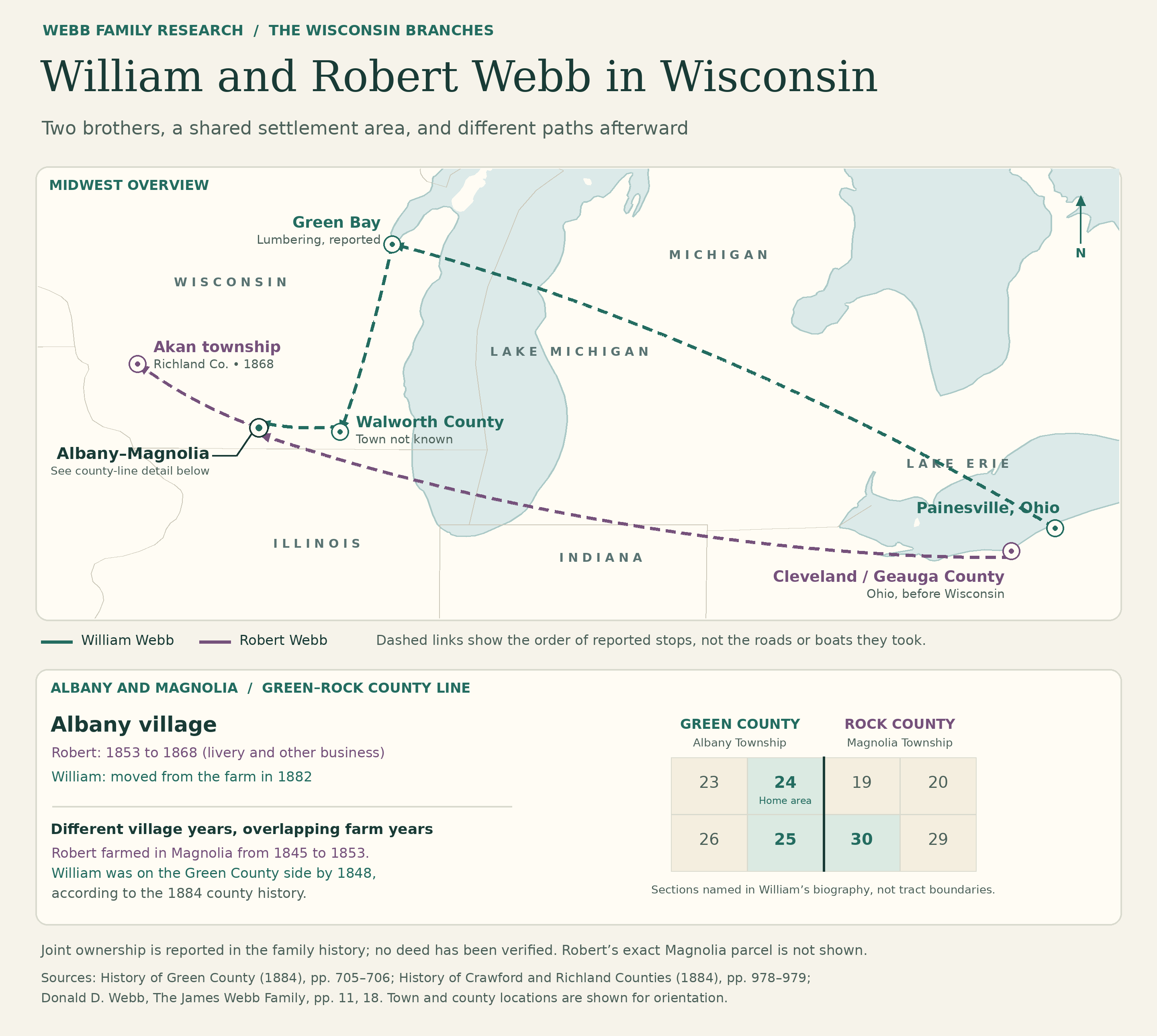
William’s path takes him through Green Bay and Walworth County to the Green–Rock county line, then into Albany village in 1882. Robert reached Magnolia in 1845, moved to Albany village in 1853, and went on to Akan in 1868.
The brothers’ years in the farm area overlapped, but the biographies place them in Albany village at different times. The inset shows William’s sections as described in the 1884 county history. Robert’s 1849 federal patent separately locates 40 acres in section 19, Magnolia; it does not verify the family account of shared land.
Sources: Green County history, pp. 705–706 · Crawford County history, pp. 978–979
Eight family branches
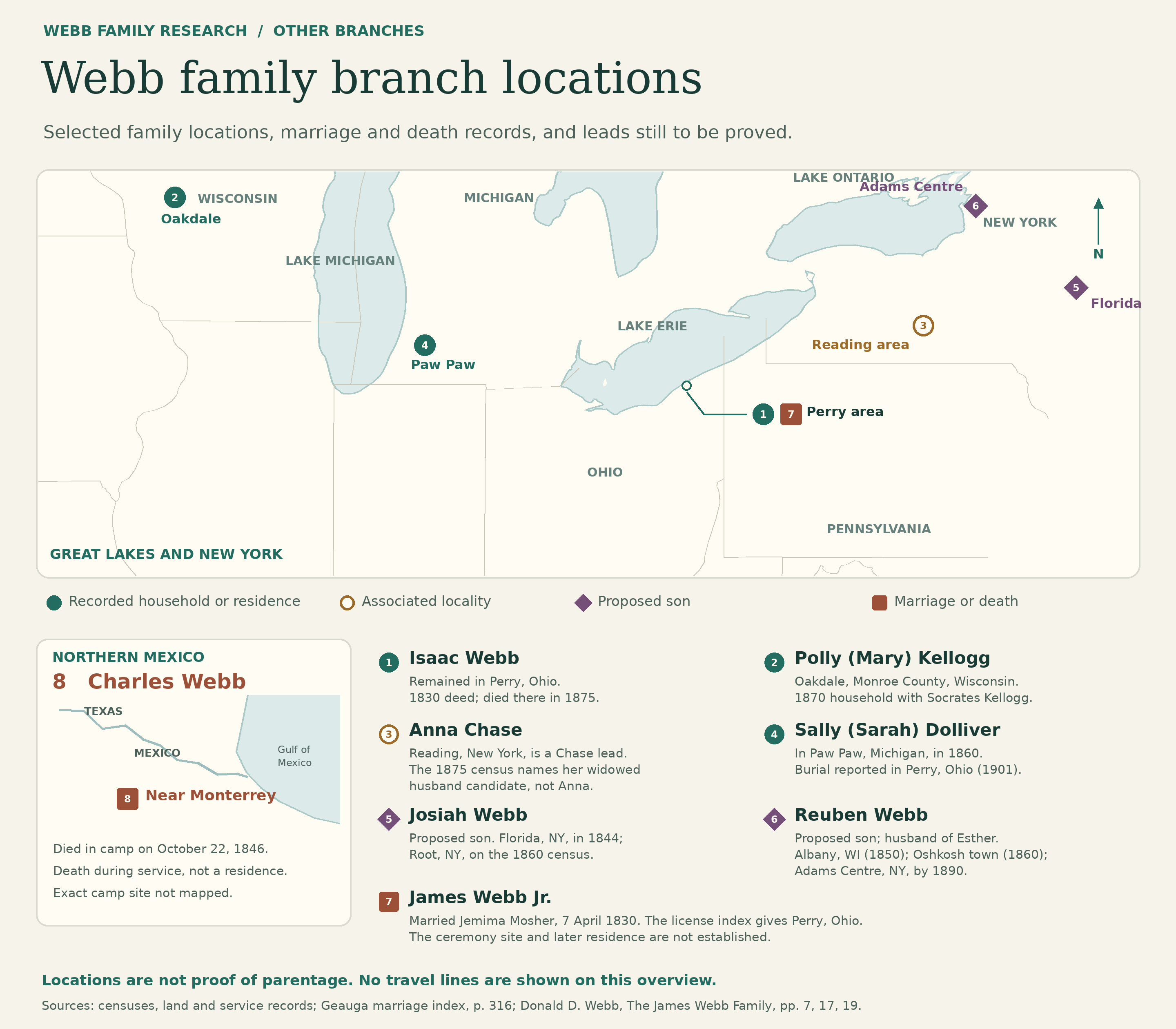
Isaac stayed in Perry. Polly (Mary) Kellogg is associated with Oakdale, Wisconsin. Her great-grandson Lloyd “Doc” Kellogg and his wife Peg made their home in Oregon, Wisconsin. Sally (Sarah) Dolliver appears in Paw Paw in 1860, with burial in Perry reported in the family history. Reading, New York, is a Chase family lead, not a verified residence for Anna. Her grandson Frederick Sidney Chase grew up and practiced law in Lafayette, Indiana. His sister Florence Sophia Chase Mead moved west to Colorado and Wyoming.
Josiah in Florida and Root, New York, and Reuben in Wisconsin and later Adams Centre, New York, are mapped as proposed sons. The inset marks Charles’s October 1846 death near Monterey (modern Monterrey), Mexico. James Jr. and Jemima Mosher’s April 1830 license index points to Perry, but the return index does not name the ceremony town. The pin marks an association, not a later residence.
Sources: Donald Webb’s family history · Geauga marriage index · 1890 veterans schedule
Evidence register
Original records, later family accounts, and working theories are kept separate. A blocked record is not a negative search. The English leads are grouped under Y-DNA research: Staffordshire. Browse the Census Image Index for family anchors, candidates, and comparisons.
Start here · James Webb’s origins
From the Webb Research Register
Record: Deed and census images. Finding: Josiah’s parents unproved.
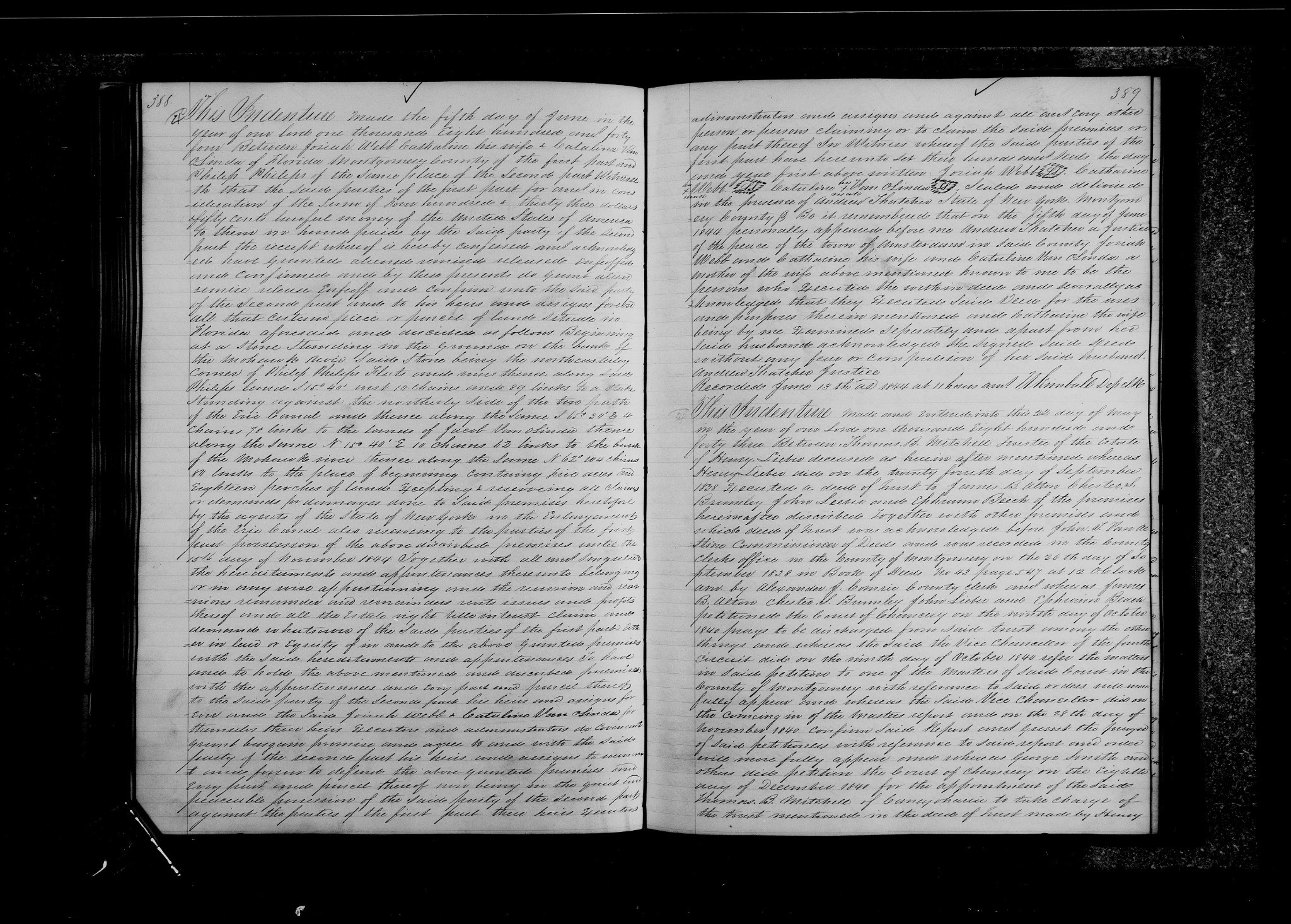
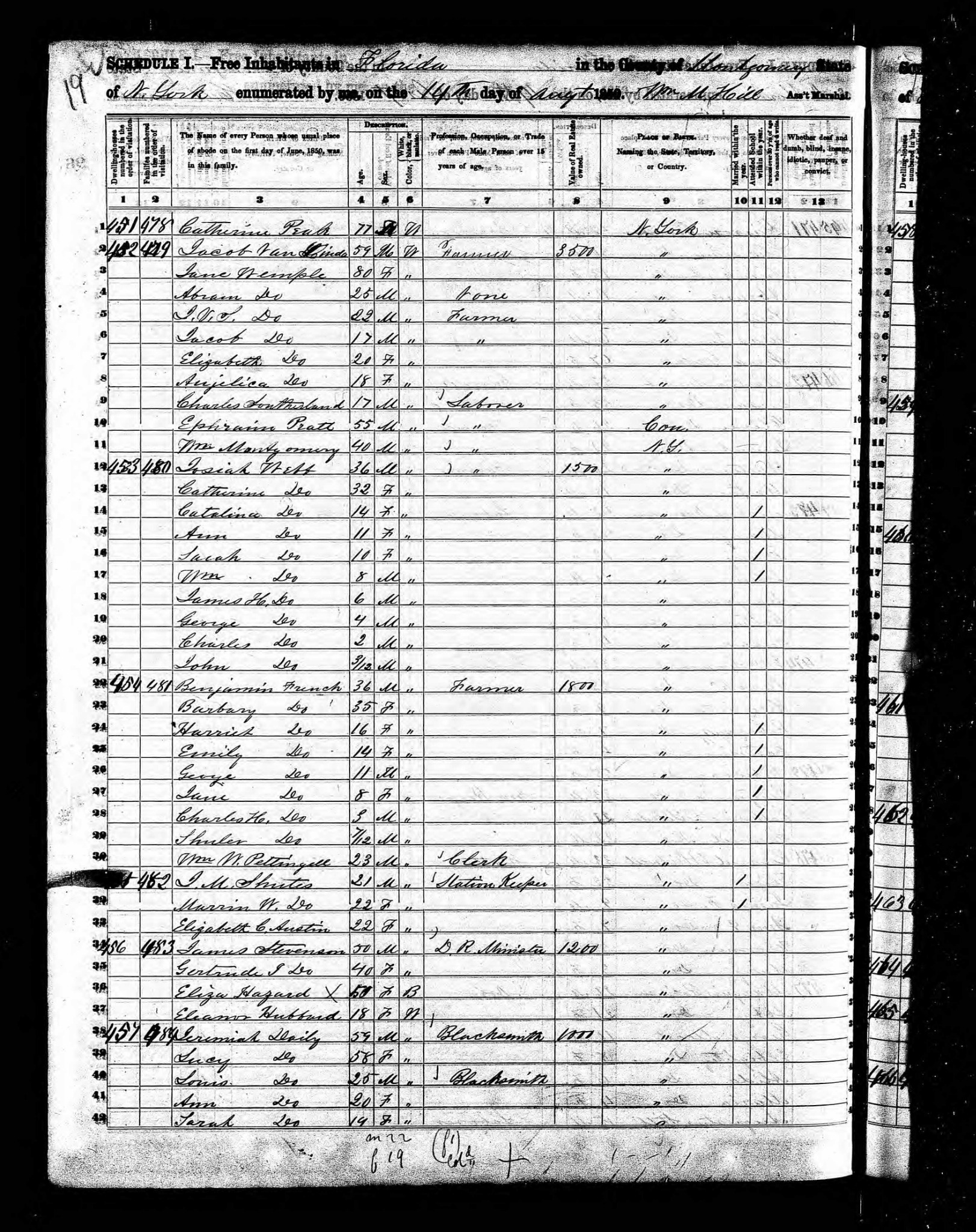
The 1844 deed names Catharine as Josiah’s wife and Catalina Van Alstine as Catharine’s mother. The August 14, 1850 census puts the Josiah and Catharine household in Florida, Montgomery County, not Palatine. Neither record identifies Josiah’s parents, proves Catharine’s birth surname, or shows that Josiah inherited the tract.
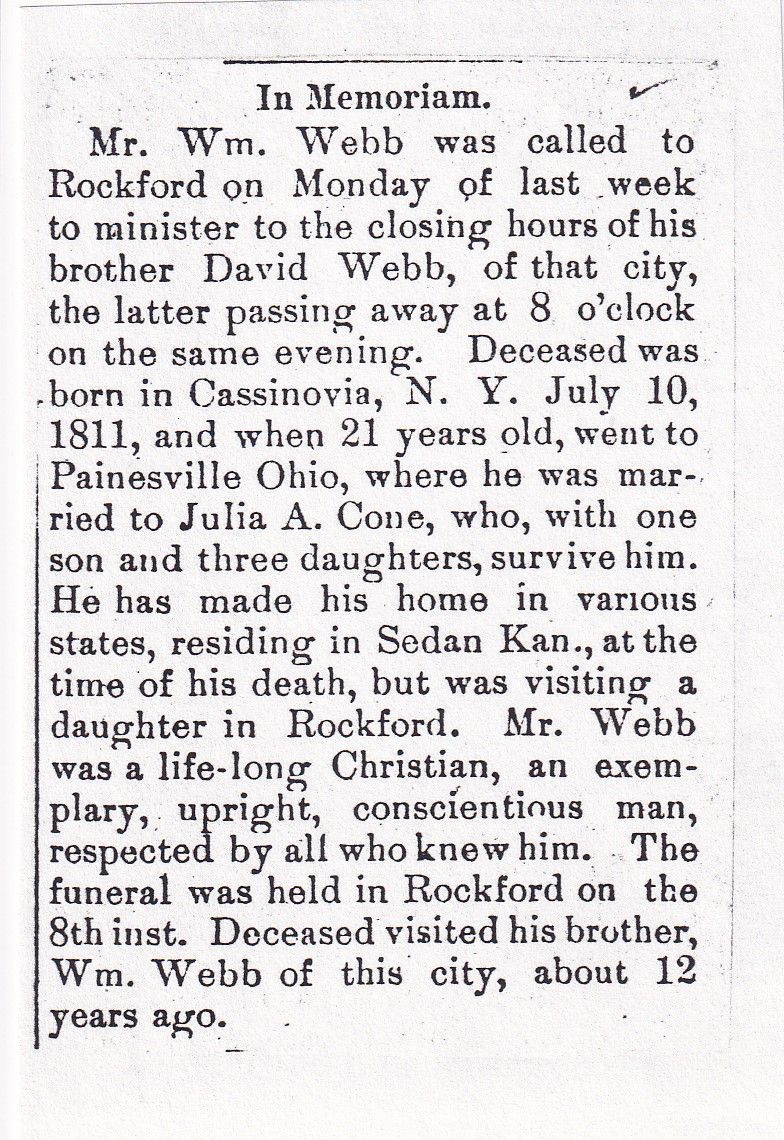
Record: Newspaper clipping and published extract. Finding: The notice directly states that David and William were brothers.
The Albany Vindicator notice calls William David’s brother and reports that William went to Rockford as David was dying. That is an explicit statement of the relationship, unlike the names in Isaac’s account book. The notice does not name their parents.
Record: Deed images. Finding: Probable identification with a different James Webb.
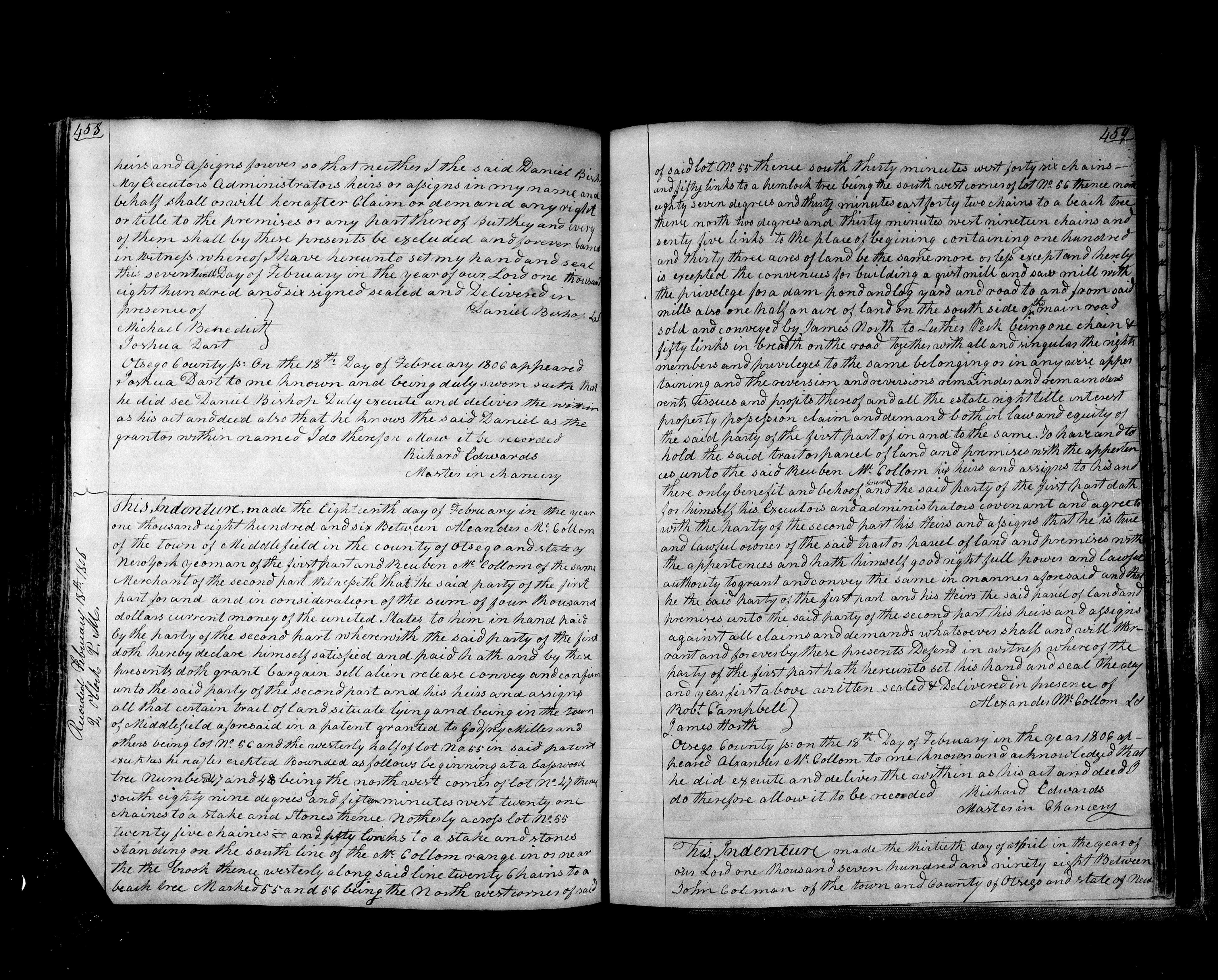
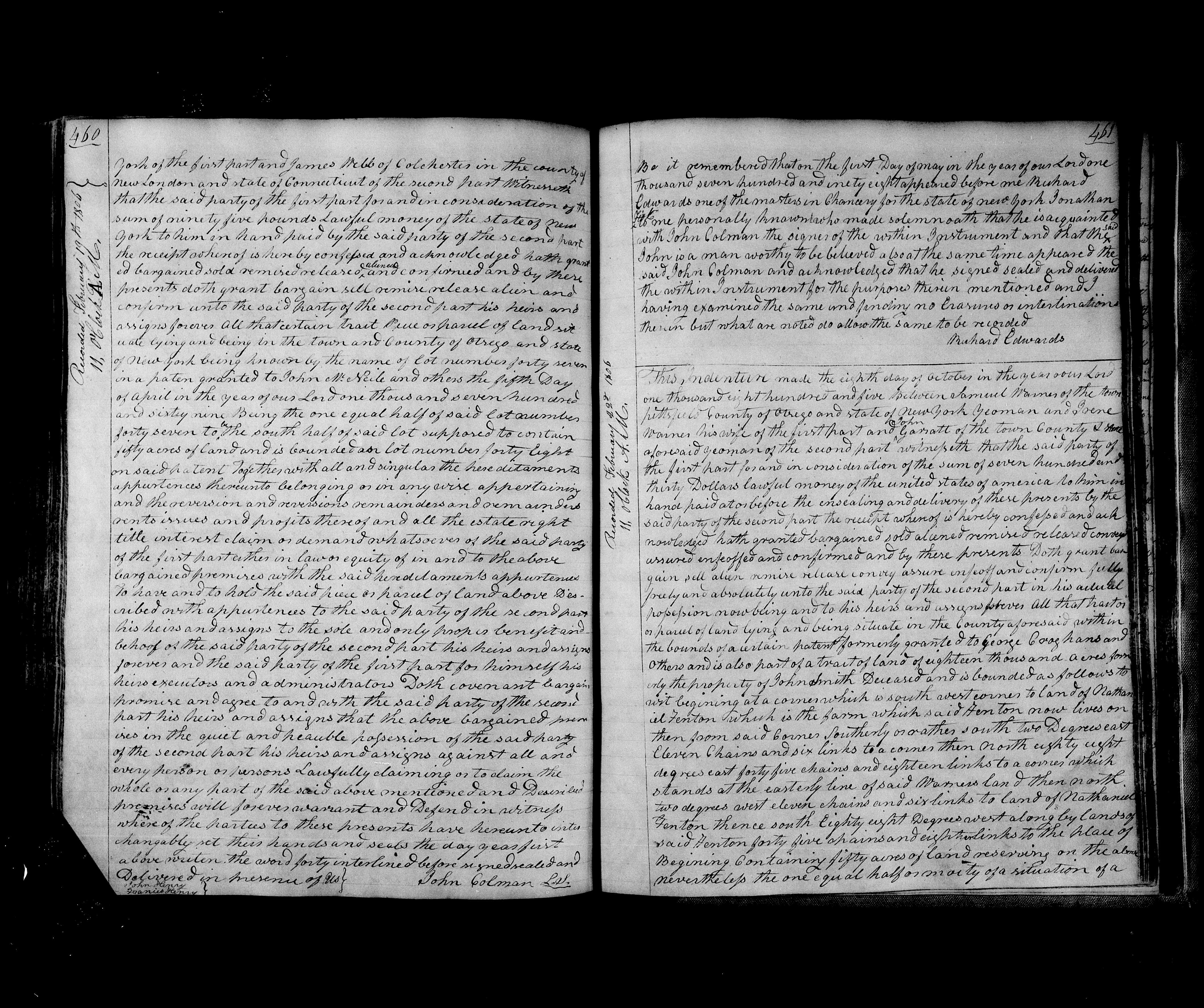
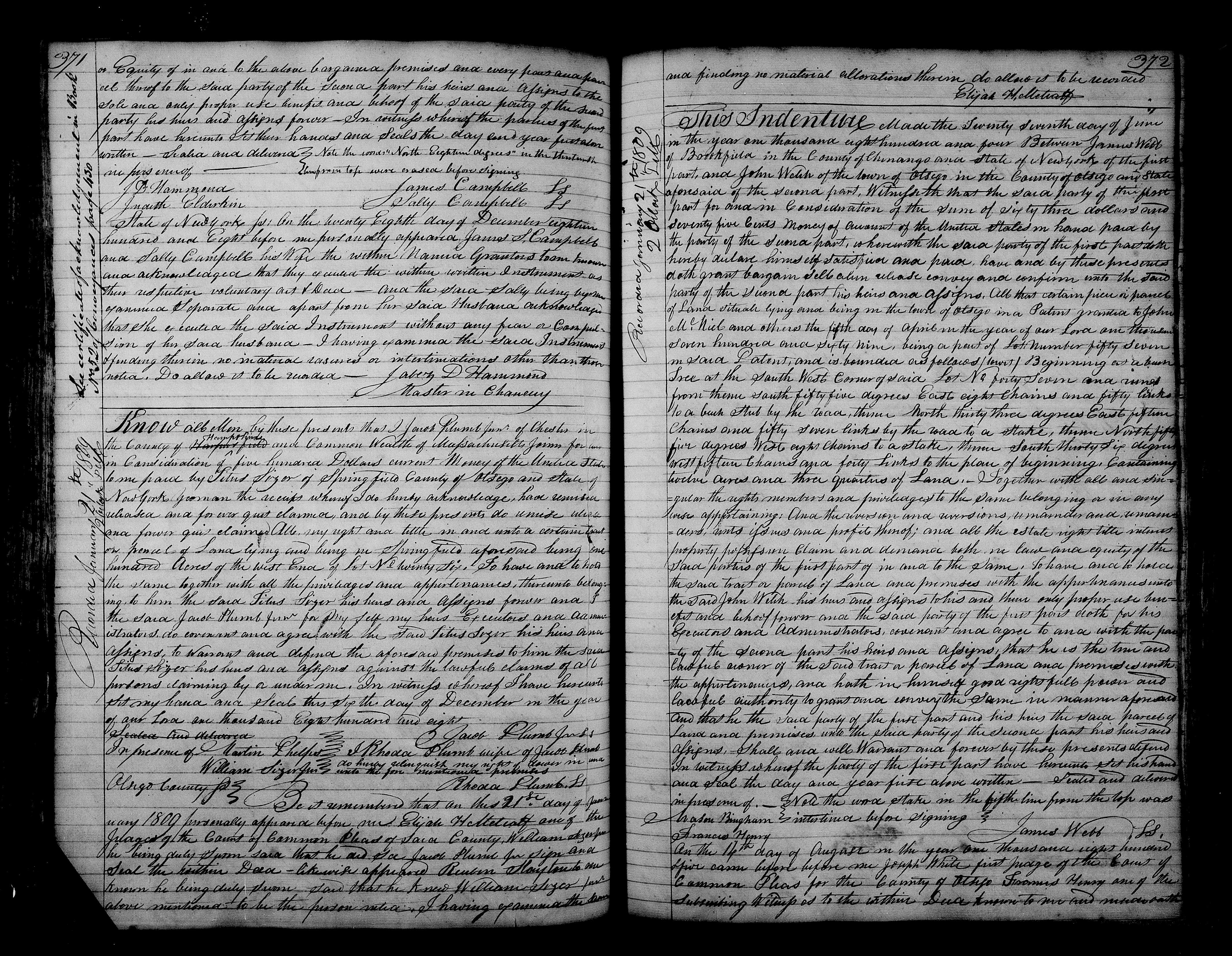
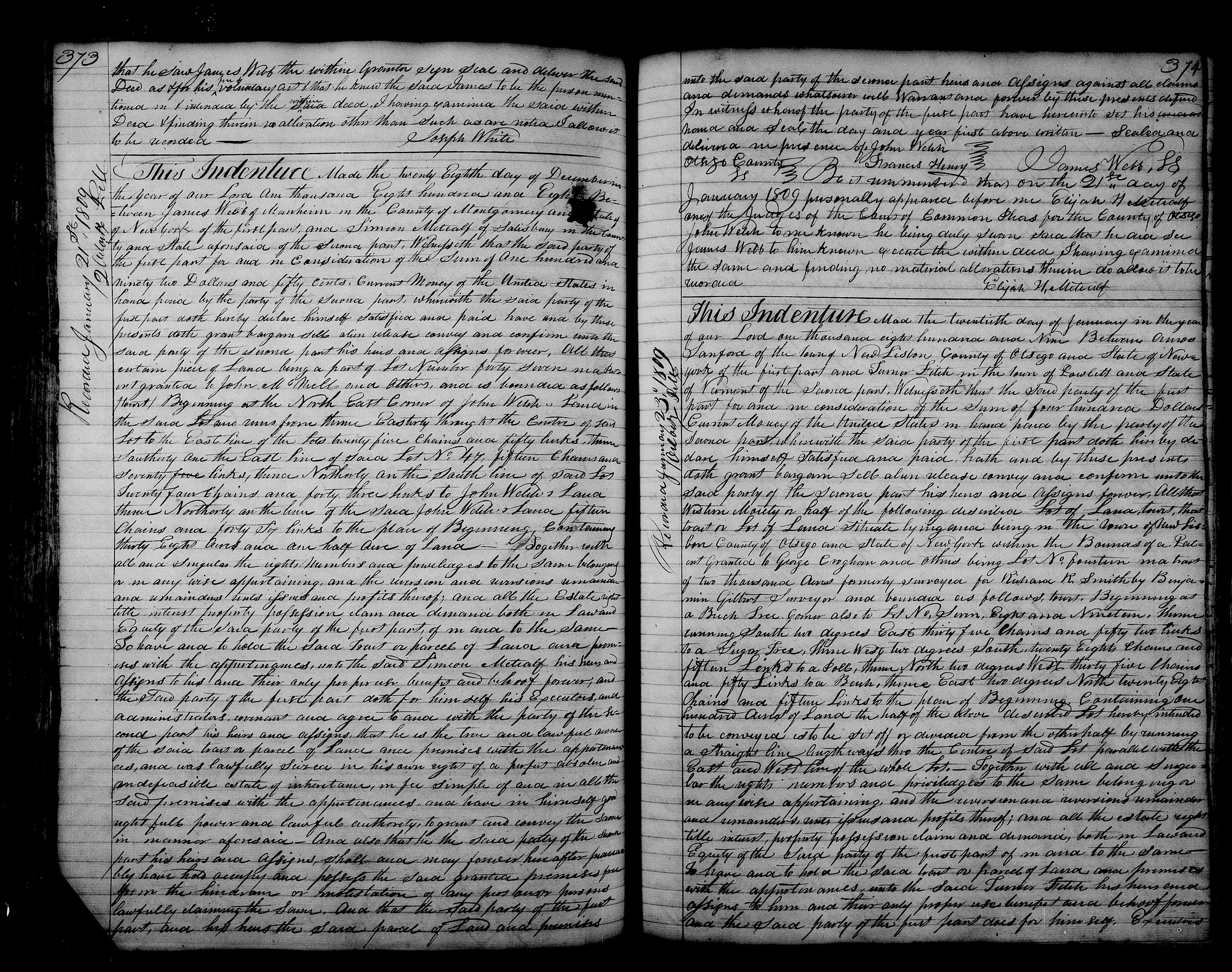
A James Webb described as of Colchester, Connecticut, bought Otsego land in 1798. Deeds name a James of Brookfield in 1804 and a James of Manheim in 1808. The patent, bounds and recurring witnesses strongly suggest one landholder, despite a lot-number discrepancy in the 1804 deed.
Family records point to the man who married Betsy Faville. No deed names her, so that identification is probable, not proved. The deeds do not establish a Connecticut origin for James, husband of Anna Scott.
Research category · Paternal line
A reported Y-DNA comparison with an English Webb line is the reason to investigate Staffordshire. The Sedgley entries below come from parish-register transcriptions. They identify people and events to investigate, but do not establish that the entries form one family or that anyone in them was an ancestor of James Webb of New York and Ohio.
Genetic genealogy
DNA can prioritize branches to investigate. It does not, on its own, identify James’s parents.
Source shelf
The legacy site, public record collections, and selected findings from the research dossier and register. This is a curated edition, not a mirror of the working files. See the David Scott source guide or the adapted Scott essay.