Woodman family · Vermont to Van Buren County, Michigan
David Woodman
1818–1904 · Also recorded as David Woodman 2d
David Woodman cleared a farm on Three Mile Lake, wrote home to Jane Harris Woodman from the California gold fields, and ran for governor of Michigan on the Greenback ticket. Their son Edson farmed next door and was the father of Bertha Woodman Webb.
David’s younger brother Jonathan J. Woodman hosted the 1877 Woodman reunion and served as Michigan House Speaker.
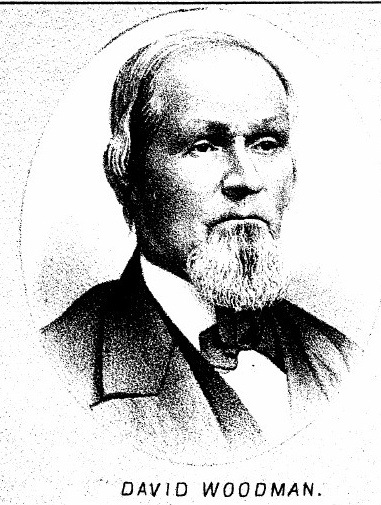
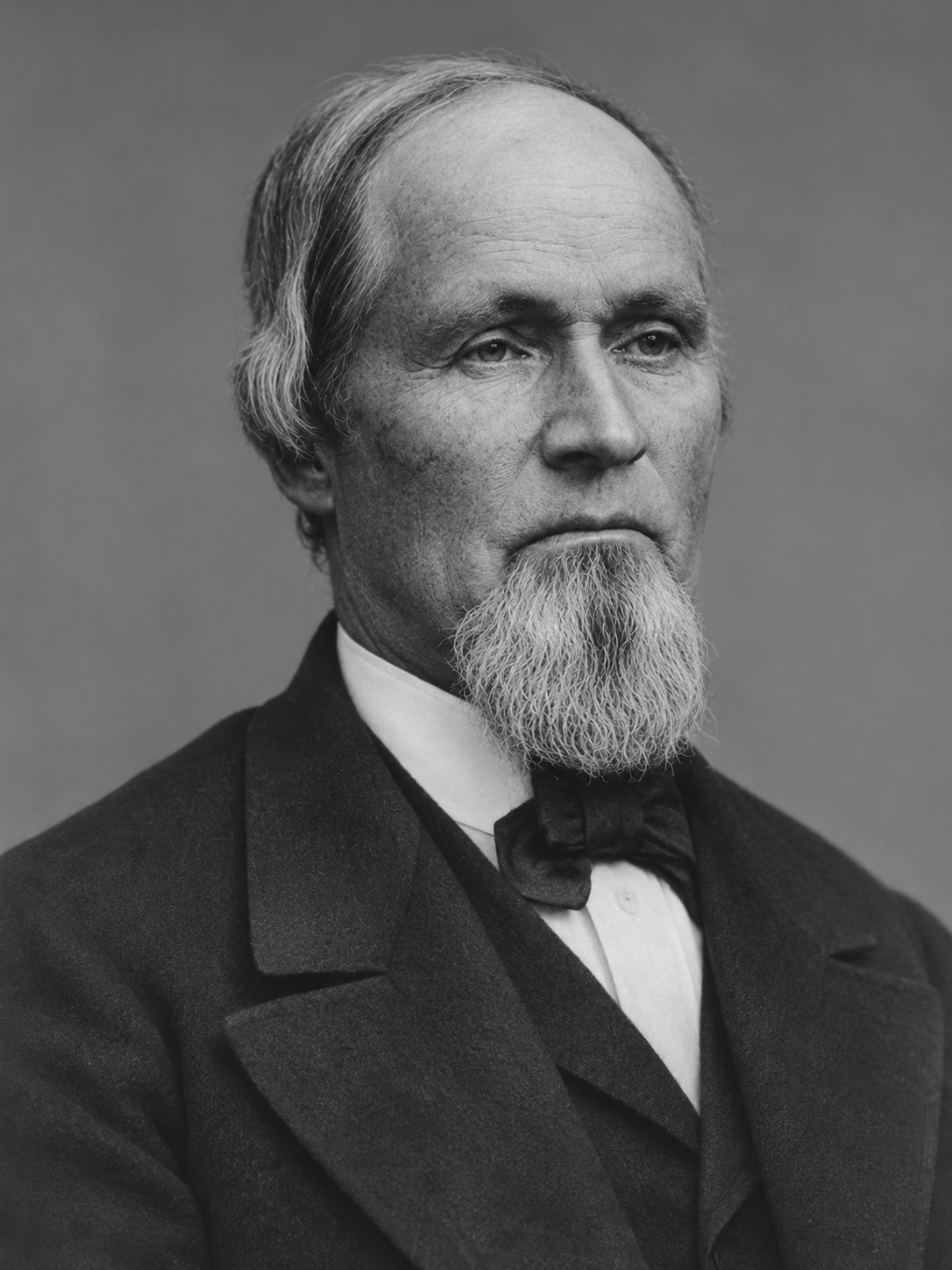
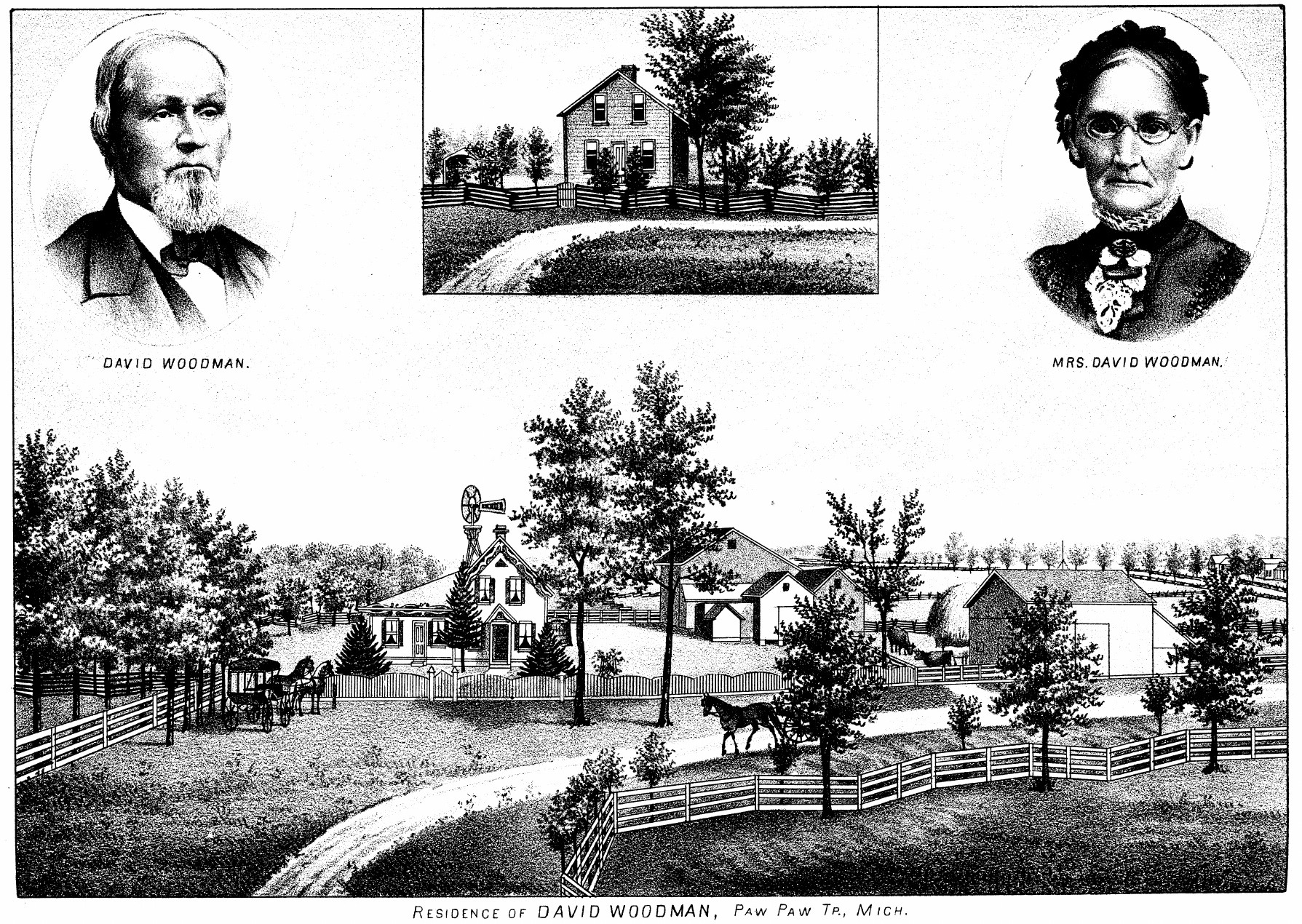
Portraits and residence
From Wheelock to Three Mile Lake
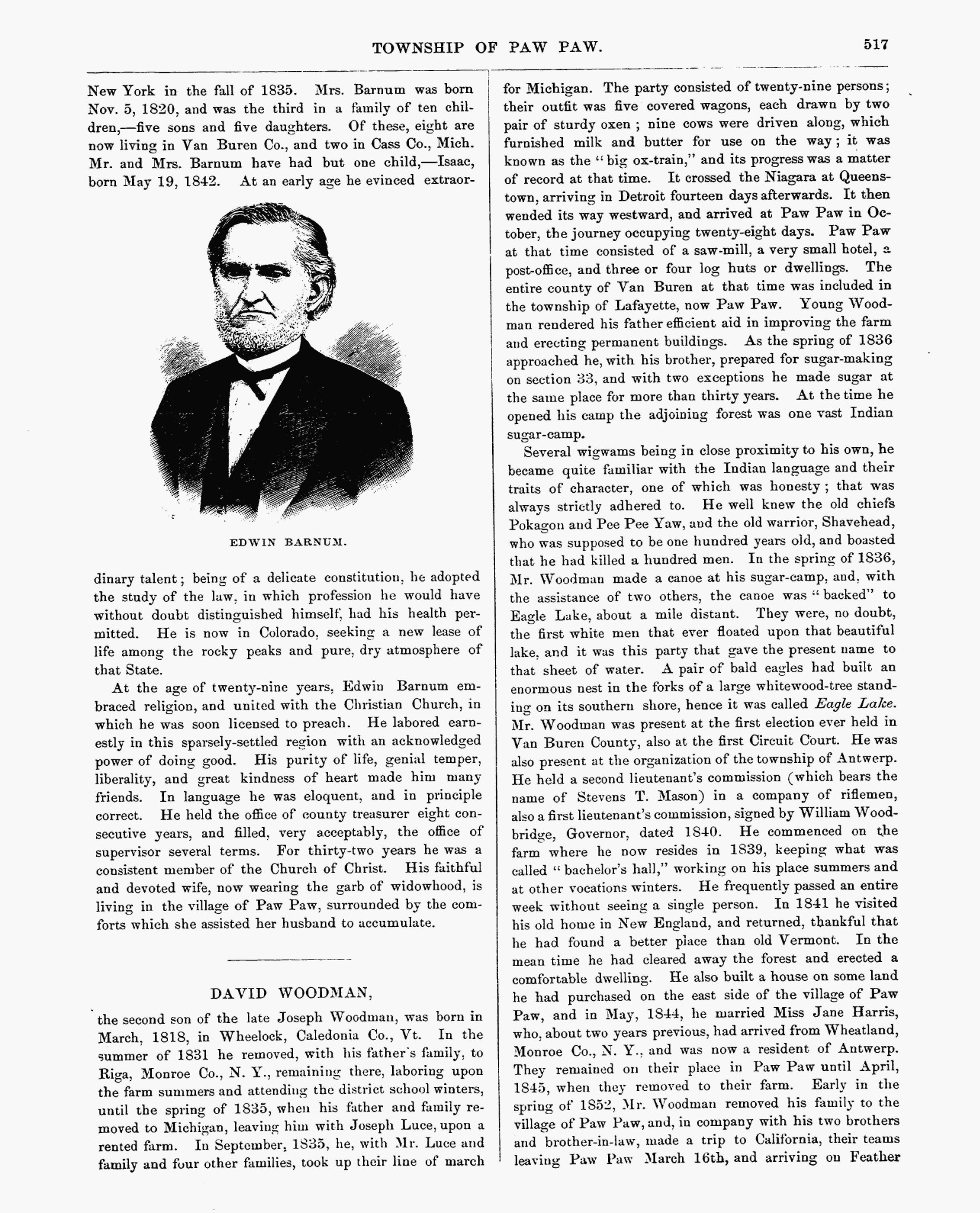
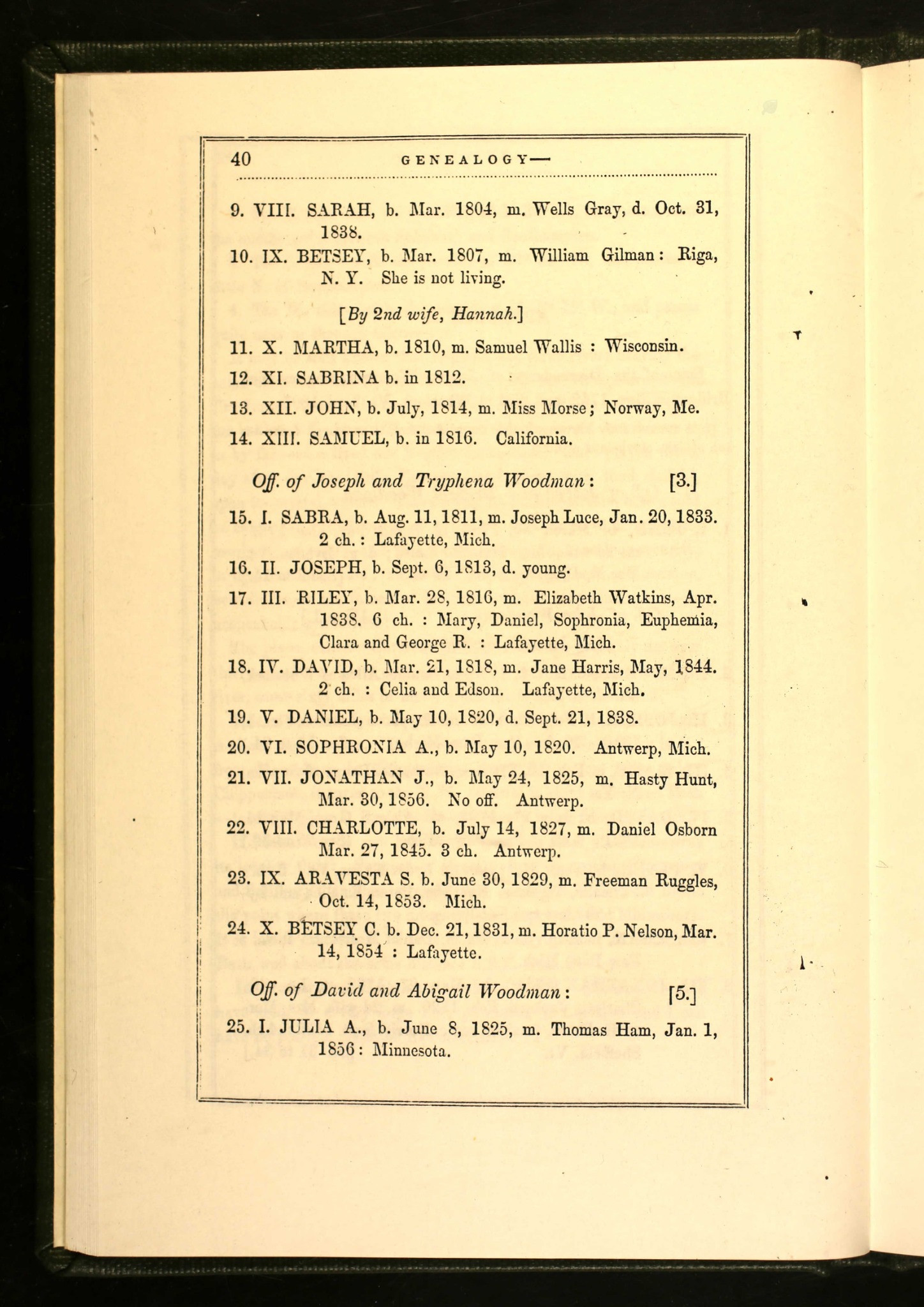
David was born in Wheelock, Caledonia County, Vermont, in March 1818, according to the 1880 county history. The 1856 Woodman genealogy gives March 21 and lists him as a child of Joseph and Tryphena (Johnson) Woodman. The family moved to Riga, Monroe County, New York, in 1831. The county history says David worked on the farm in summer and went to district school in winter.
Nancy E. Robinson’s 1992 compilation preserves a recollection attributed to David that distinguishes two trips in 1835. His father Joseph and most of the family went in the spring, crossing Lake Erie to Detroit and traveling overland through Kalamazoo. Joseph recalled moving his family into a new cabin near Paw Paw on May 10. David stayed behind and later traveled with his sister Sabra and her husband, Joseph Luce. In the account Robinson preserves, their 29-person party left Monroe County on September 25 with five covered wagons, crossed the Niagara from Lewiston by horse-powered ferry, traveled through Canada, and took a steam ferry to Detroit. They reached Paw Paw on October 25. The 1880 county history also puts David in Luce’s October party and names Queenston, across the river from Lewiston. Rowland’s 1912 history gives May for David himself; the two-trip account may explain the discrepancy, though the original newspaper series has not been located. Rowland also explains that David was called David Woodman 2d during his uncle David’s lifetime. [1] [3] [12, pp. 1–2]
The 1880 account places him and his brother at a maple sugar camp in 1836, beside camps already used by Indigenous sugar makers. In a talk to the Van Buren County Pioneer Association on June 14, 1899, David recalled beginning his own farm on the west side of Three Mile Lake in spring 1839. Rowland printed part of that talk. It preserves David’s late-life recollections, not a contemporary record of the farm’s establishment. [1] [3]
A return visit to Vermont in 1841
In the account preserved by Robinson, David remembered a 13-day journey to Caledonia County: stagecoach from Paw Paw to Ann Arbor, rail to Detroit, boat to Buffalo, then an Erie Canal line boat to Troy Junction. He continued north by canal to Whitehall, by way of Lake Champlain to Burlington, and by stage to Caledonia County. He recalled choosing the slower canal boat at one cent a mile, meals and lodging included. [12, p. 3]
Read more about Sabra Woodman and Joseph Luce, including the later Woodman family reunion.
Jane Harris and their children
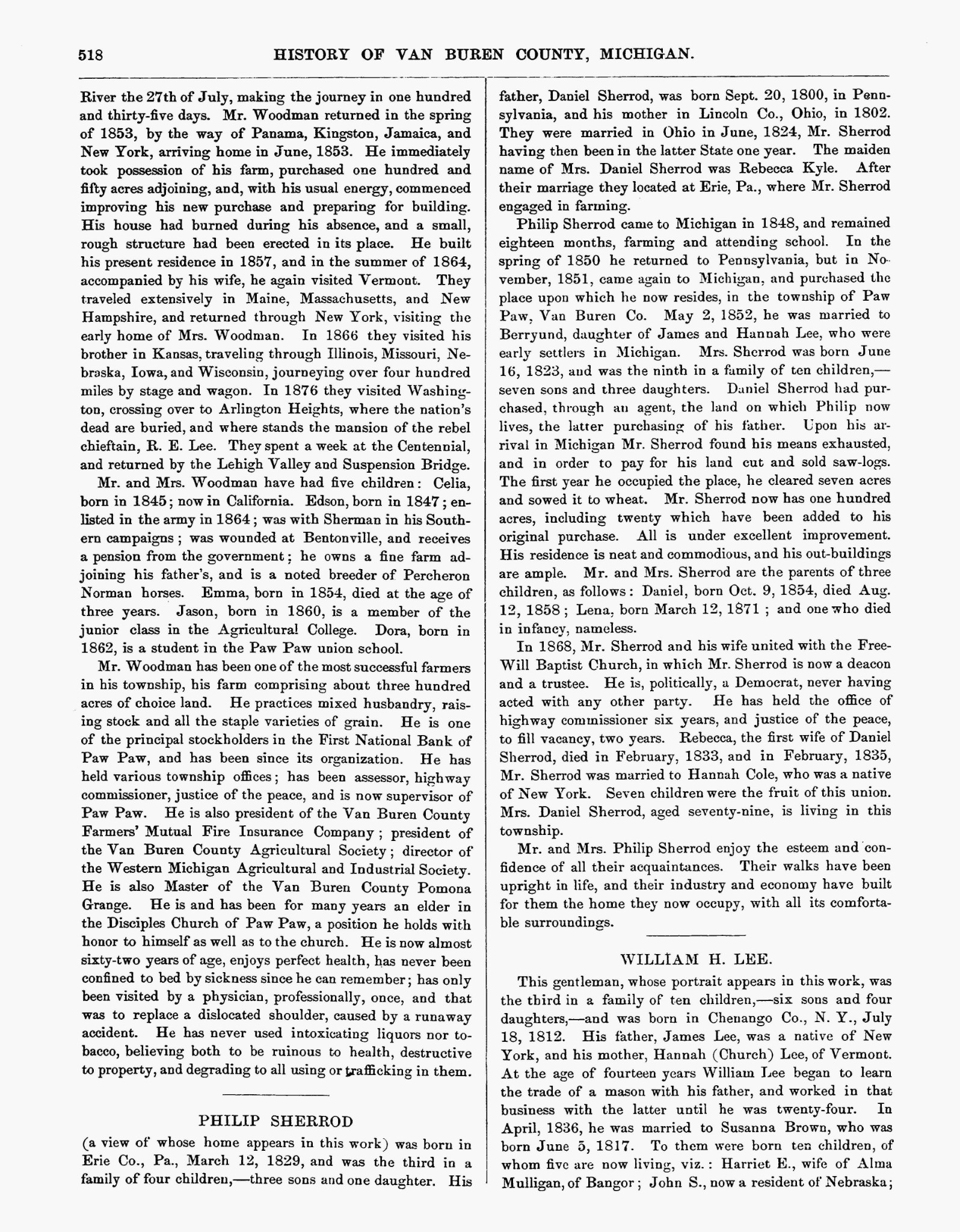
David married Jane Harris in May 1844. The 1880 county history says she had come from Wheatland, also in Monroe County, New York, and was living in Antwerp Township. The couple initially lived in the village of Paw Paw and moved to the farm in April 1845. The same history names five children: Celia (1845 in the county history), Edson (1847), Emma (1854, died at about age three), Jason (1860) and Dora (1862). The earlier genealogy lists Celia and Edson; it is not a complete account of the family. [1] [2]
The Gold Rush, in letters to Jane
David moved his family into the village before leaving for California in 1852 with two brothers and a brother-in-law. The 1880 account dates the departure of their teams to March 16 and their arrival at the Feather River to July 27. It describes a different return route in 1853: through Panama, Kingston, Jamaica, and New York, arriving home in June. His house had burned while he was away. The county history says he bought another 150 acres adjoining the farm and built a new residence in 1857. [1]
The David Woodman Papers at Michigan State University preserve letters to Jane from 1852–1853. The archivists describe riverboat and wagon-train travel, life in the mining country, and David’s increasingly doubtful view of making a fortune from gold. The inventory lists a pocket letter book dated October 17, 1852, in folder 2, and a photograph filed under “People. Woodman, David.” The finding aid is online; the individual letters and photograph were not examined for this biography. [4]
A farmer in public life
By 1880 the county history described a farm of about 300 acres, with both livestock and grain. It also lists David as township supervisor, an elder in the Disciples Church, and master of the county Pomona Grange. He had previously served as assessor, highway commissioner and justice of the peace. The 1877 state business directory independently lists him as president of the local mutual fire insurance company. [1] [5]
Woodman was the Greenback candidate for governor in 1880, not 1878 as a later Paw Paw walking-tour brochure says. The August 12, 1880 Ingham County Democrat names him as the nominee. Michigan’s published election totals give him 31,085 votes, third behind David H. Jerome and Frederick M. Holloway; the 1878 Greenback candidate in those returns was Smith. [6]
In a signed October 5 campaign letter to Gen. T. A. Granger, Woodman described himself as a longtime temperance advocate and said Michigan voters should be allowed to decide on the proposed prohibition amendment to the state constitution. The Grange Visitor printed his reply on October 15. [10]
Farming remained his calling. In 1887 The Grange Visitor reported that he brought 428 individual entries of grains and grasses to the West Michigan Fair, all grown on his farm. [7] At the 1876 Centennial Exhibition in Philadelphia, Michigan’s state report lists Woodman as one of the Van Buren County superintendents appointed to collect and forward specimens. The official history of the 1893 World’s Columbian Exposition in Chicago records that he exhibited five kinds of cereal crops. The Ingham County Democrat lists him among the cereal prizewinners, but does not identify his specific award. [11]
The Paw Paw Historical Commission identifies a different, later home David and Jane built in the village in 1883. Its walking tour also credits David with a corncob family display at the 1893 Chicago World’s Fair; that detail has not been checked against a fair-era record. [8]
David died in 1904. A published index locates an obituary in the December 10, 1904 Christian Standard, p. 1776. The obituary itself has not been read, and the date of the issue is not a date of death. [9]
David and Jane’s monument
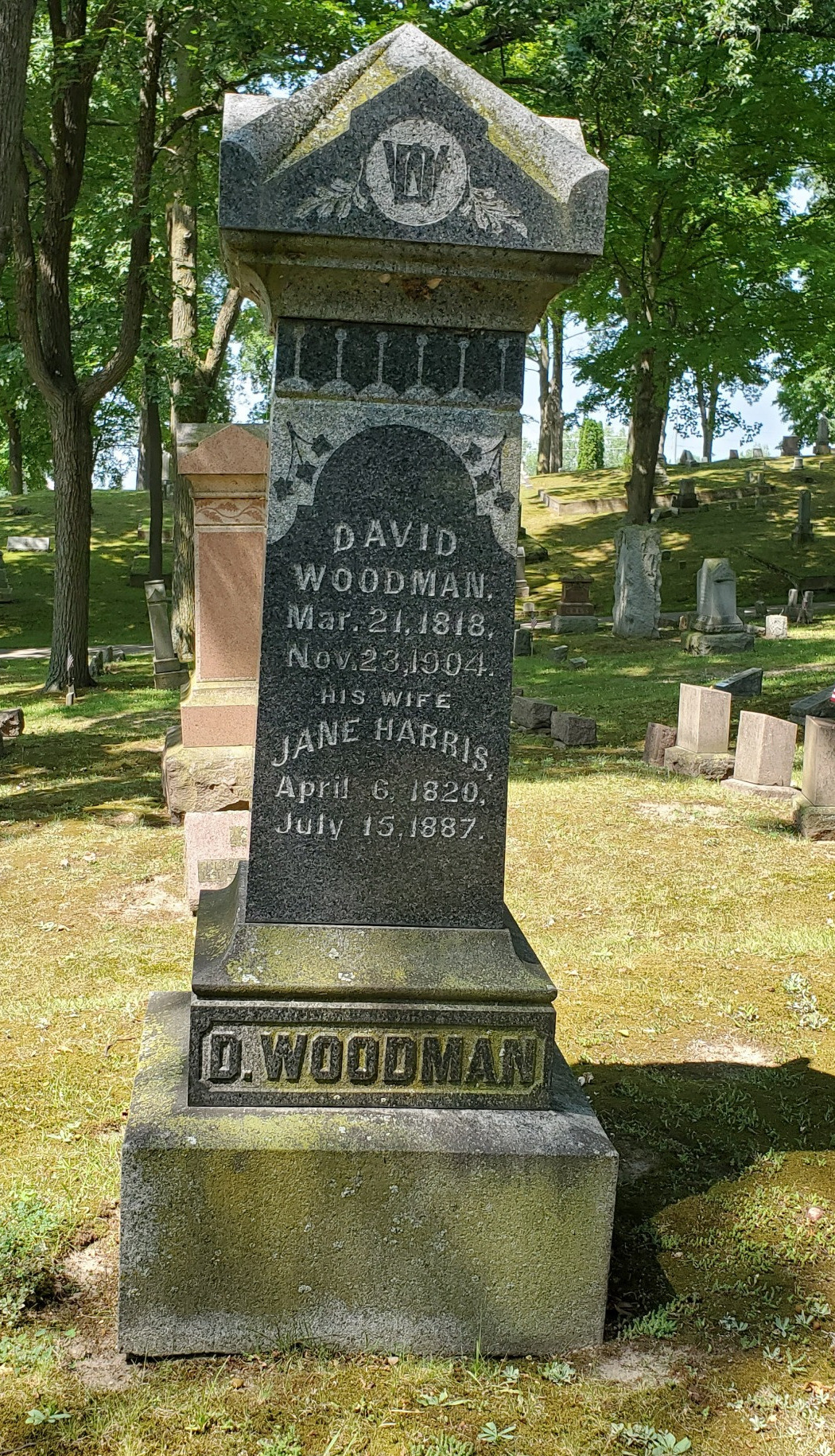
See also their son Edson Woodman’s monument.
Sources and record images
- History of Berrien and Van Buren Counties, Michigan (D. W. Ensign & Co., 1880), David Woodman sketch: p. 517 and p. 518, scans supplied by the family. Residence and portraits, plate facing p. 502; the portrait on p. 517 is Edwin Barnum, not David Woodman. See also the preceding sketch of Elder Joseph Woodman.
- J. H. Woodman, A List of the Descendants of Mr. Joshua Woodman (1856), appendix B, p. 40, entry 18, family-supplied scan. A compiled genealogy, not a birth or marriage register.
- O. W. Rowland, A History of Van Buren County, Michigan (1912), vol. I, pp. 571–572 and following, “David Woodman’s Pioneer Pictures.”
- David Woodman Papers, c.00128, Michigan State University Archives & Historical Collections, finding aid.
- Michigan State Gazetteer and Business Directory (1877), Paw Paw.
- Ingham County Democrat, August 12, 1880; Michigan Manual, 2023–2024, p. 817, summary of gubernatorial votes.
- The Grange Visitor, October 1, 1887, p. 5, report on the West Michigan Fair.
- Village of Paw Paw Historical Commission, Historical Walking Tour, entry 8, Woodman House.
- Christian Standard Index, 1866–1966, vol. 4, “David Woodman [obit],” December 10, 1904, p. 1776. This is an index citation, not the obituary.
- David Woodman, “Mr. Woodman’s Reply,” The Grange Visitor, October 15, 1880, p. 5, letter dated October 5.
- Report of the State Board of Centennial Managers, pp. 41–42; A History of the World’s Columbian Exposition Held in Chicago in 1893, “Agricultural Exhibits,” pp. 6–7; Ingham County Democrat, November 23, 1893.
- Nancy E. Robinson, compiler, family account of David Woodman, March 1992, pp. 1–4. Robinson drew on the 1880 county history and a series of newspaper articles she dates to about 1894 and attributes to David. The original newspaper issues have not been verified. Family copy supplied by Mark Webb.
- Shared monument for David Woodman and Jane Harris, family photograph supplied by Mark Webb.