Research history · 2000s
Early Webb research
Legacy research appendix: Establishing the sons
This appendix reconstructs the evidence trails and working ideas in Mark Webb’s 2005 essay Establishing the Sons of James and Anna (Scott) Webb and the companion Current Findings & Research page from the 2003–2007 site. It records what those pages reported and what their sources can show. It is not a current roster of proven children or a conclusion about James’s parents.
How the early family researchers assembled the list
In his 1961 The James & Anna Scott Webb Family, Wilford J. Webb reported seeing William, David, and Robert Webb named in Isaac’s account book, with an age memorandum. A partly torn last page gave Albany, Wisconsin, as the address of William and Robert. The account book did not call the men Isaac’s brothers; that was the family researchers’ interpretation. Wilford and Harland Webb combined this clue with other family records and identified Isaac, David, William, Charles, and Robert as sons. Wilford’s 1950s fieldwork also turned up James and Reuben as possible sons. Donald Webb revisited the family in his 1979 James Webb Family; a separate compilation by Harland and other relatives pointed to the Old Webb Bible. These accounts preserve valuable leads, but a later transcription or compilation is not the original account book or Bible.
The brotherhood evidence and its limits
- Isaac and David. The 2005 essay traced Isaac through his 1828 marriage to Emeline Cone, Perry censuses from 1830 to 1870, and Ohio death and cemetery evidence. It cited William Whitney Cone’s 1903 genealogy and Francis Bacon Trowbridge’s 1891 Champion Genealogy. The essay identified Isaac’s signature on David’s 1833 marriage application. Salmon Cone’s will names Emeline Webb and Julia Anna Webb as his daughters. The two Webb men’s marriages to the Cone sisters and Isaac’s involvement with the application are links between the families, not explicit statements that the men were brothers.
- David and William. The Green County Genealogical Society transcription, p. 9, is filed under the July 16, 1891 Albany Vindicator (heading on p. 8). It identifies David as William’s brother and says William was called to Rockford on the day David died. The society’s transcription lists one surviving son and three daughters; Mark Webb’s 2004 David Webb Family Group Sheet (source 12) gives three sons and one daughter for the same notice. The original Albany issue is needed to settle the wording. The essay separately cited the Rockford Morning Star funeral notice of July 8, 1891 (p. 5, col. 4), Winnebago County death records, cemetery evidence, and Anderson Cone Webb’s Bible. It traced David’s moves through Ohio census and land records, the 1858 Paw Paw land record and 1870 census, and the 1880 Sedan, Kansas, census. The biographies of David’s children Milo (Cutler’s 1883 Kansas history) and Anderson (1880 Berrien and Van Buren county history) offered additional trails.
- Robert and William. The Green County Genealogical Society transcription, p. 3, reports that William Webb of Albany received a telegram about the death of his brother Robert of Richland Center. The section heading gives only April 1896; the notice itself gives the 24th of the month without naming the month. Donald Webb’s compilation, pp. 18–19, cites April 1 and infers a March death. The Richland County History Room newspaper index independently lists two death notices for Robert Webb: Richland Rustic, April 25, 1896, p. 3, col. 4, and Republican Observer, April 30, 1896, p. 8, col. 3. These are publication dates, not death dates. The local notices make April 24 a stronger candidate for the Albany notice’s 24th, but neither original Richland notice has been read. The exact date remains unresolved. The transcribed estimate of about 64 also conflicts with the 1825 birth year in Robert’s lifetime county biography and the family history, which would make him about 70 in 1896.
- Charles. The essay relied on Mexican War and family claim records. In her 1849 sworn declaration, Anna named James as her husband and Charles’s father. This is a more direct statement of parentage than an account-book association.
These are later transcriptions of the Albany notices, not issue images. They corroborate that William was a brother of both men, but do not identify their parents. The Wisconsin Historical Society holdings guide files the earlier Vindicator under Albany Herald (printed p. 103). The Illinois Newspaper Project listing for the Morning Star identifies a Rockford Public Library run that covers 1891.
Why the Wisconsin accounts need to be checked
William’s 1901 sketch in the Commemorative Biographical Record gave 1841 for his father James’s death, while Anna’s sworn statement places it around February 6, 1835. The sketch also called Enos Scott Anna’s grandfather; the Scott evidence identifies Enos as her brother. The legacy essay gave 1842 for William’s marriage to Fanny Rice, but the Bible image has also been read as 1841. The date should not be settled by repeating the older essay.
In May 1927, Jessie (Sutherland) Weirich, a granddaughter of William of Albany, made a notarized statement presented as a Bible record. It placed James as a son of William and Lois (Strong) Webb of Perch River, New York. The early researchers found that some entries fit William of Albany and some fit the Perch River family, but others did not match the records they had assembled. Wilford’s and Donald’s accounts also questioned the proposed parentage. Notarization establishes the form of the statement, not the accuracy of the genealogy or the provenance of the underlying Bible entries.
James Jr. and Reuben: two unresolved cases
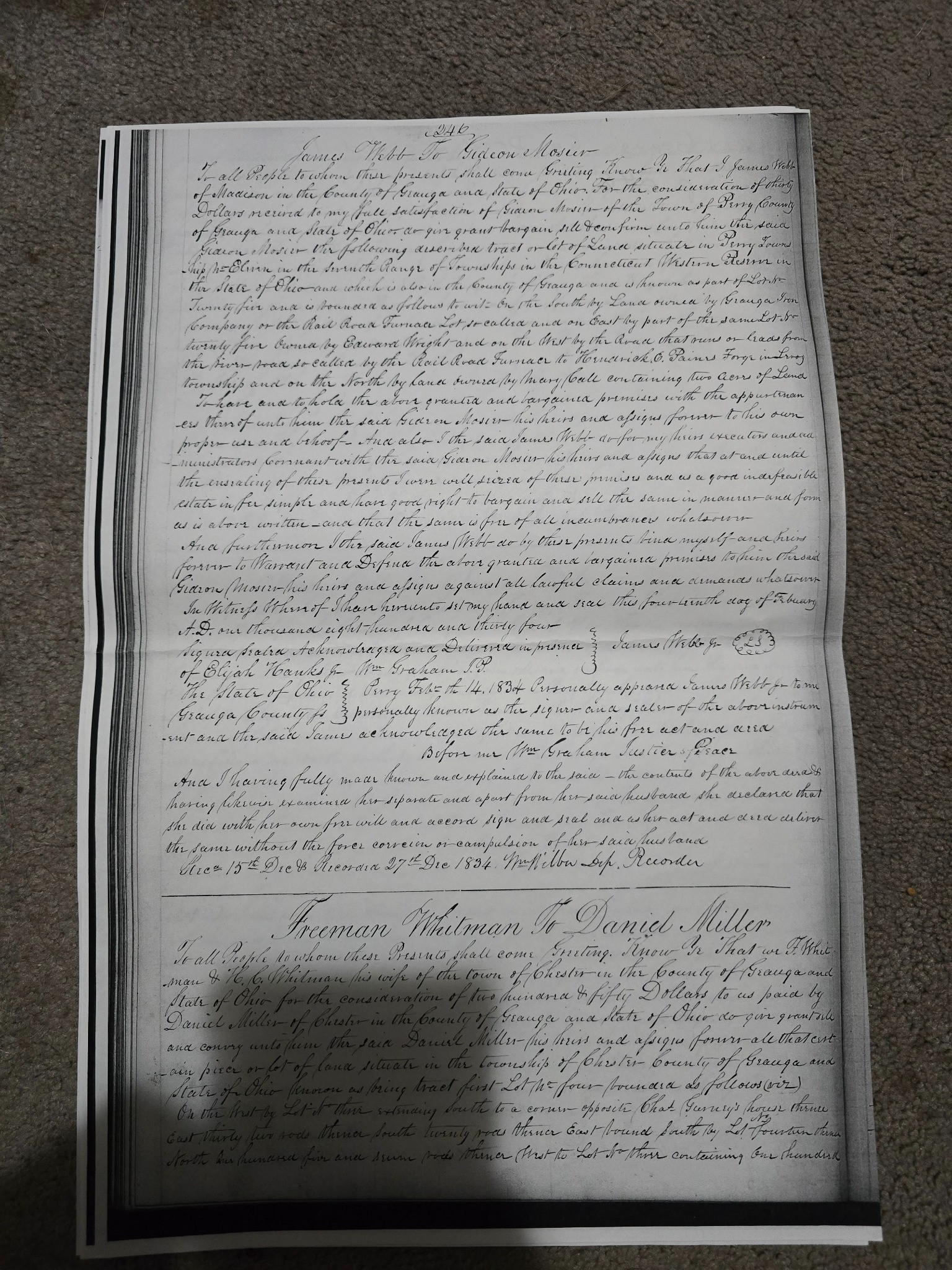
The essay associated a James Webb in the 1830 Perry census near Isaac with Jemima Mosher’s 1830 marriage record and with possible land records. An 1834 Perry deed now gives a distinct, citable reference to James Webb Jr. of Madison, but neither the suffix nor the deed establishes his parents or confirms that he was Jemima’s husband. The legacy estimate of a birth around 1808 was not an established date.
The essay tracked a Reuben Webb through an 1848 federal land record in Rock County, Wisconsin, and the 1850 Albany census, on the same page as William. It also pointed to Reuben’s marriage to Esther Webb, the Adams area of Jefferson County, New York, and old Adams Chapter DAR material identifying Esther as a daughter of a Revolutionary War patriot. The essay reported that Esther was a daughter of William Webb of Perch River. The essay noted William Scott’s son of the same name in Adams and suggested that Esther’s marriage complicated the Weirich account. These are clues for identifying the people and testing their relationships, not proof that Reuben was a son of James and Anna. The reported military service likewise requires a record tied to the right Reuben.
Where the old research looked for James’s origins
- Saybrook, Haddam, and Onondaga County. The earlier survey considered a James Webb of Saybrook and the family of Haddam founder John Webb. It cited Benjamin Webb of Lafayette (LaFayette), Onondaga County, as a reported descendant of John and a reason to examine that branch. It also considered James Webb in the 1810 Manlius census, near Cazenovia, where David’s birth was reported in 1811. Benjamin’s presence and geographic proximity do not identify the Manlius man as the James of Westmoreland. The old survey distinguished a second James in the town of Onondaga, with a longer public-service record.
- Westmoreland and the Erie Canal. The survey suggested a move around the start of canal construction at Rome in 1817, pointing to the 1820 and 1830 Westmoreland censuses, the old survey’s failure to locate the Manlius James in the 1820 census, and a War of 1812 muster note about a James Webb not accepted because he had moved. These clues do not establish that the men were the same, that James worked on the canal, or that the canal prompted a move.
- Lowville and the Disbrow lead. The Scott family’s presence in Lowville led researchers to examine local Webb households. They suggested that the name Disbrow Webb might point to Josiah and Susannah (Disbrow) Webb of Fairfield, Connecticut, and considered a possible line through the Rev. Joseph Webb of Stamford. The old survey treated this as secondary and noted that some researchers identified Joseph as a son of Richard Webb of Stamford. Neither a distinctive name nor proximity to the Scotts establishes a line to James.
See the current evidence register for the archive’s present reading.