The people behind the records
How this Archive Began
Before there was a website, there was a family round robin. Ella Grace Webb coordinated it, and Dorothy Webb Robinson helped circulate the research. Letters and quarterly updates gave relatives a way to compare notes long before they could share records online. [4]
Preserving the Webb Family Story
The researchers below carried the Webb story from one branch to the next. They preserved different kinds of evidence, from faces in family photographs to notes on what the records did not support.
Altha Webb Francis: putting names to faces
When Wilford came to Albany, Wisconsin, in 1951, Altha shared a family letter that gave him a line of ancestry to investigate. Donald later credited her with helping Wilford find the Wisconsin relatives. She knew the old farms and graves and could name most of the people in the photographs she kept. Those identifications were evidence the family might otherwise have lost. Altha’s connection ran through her father Arthur and grandfather Albert to William Webb, one of James and Anna’s sons. [1] [2] [3]
Wilford J. Webb: testing the family story
Wilford began with research assembled by his brother Harland, an account book associated with Isaac Webb, and family letters. He followed the clues from Ohio to Wisconsin and then checked the claimed link to the Revolutionary War veteran William Webb of Perch River, New York. His 1952 field notes explain why he found that identification unconvincing. He drew his 1951–54 work together in 1961 as The James & Anna Scott Webb Family. His willingness to record what did not fit is as valuable as the relatives he found. [1] [3] Read Wilford’s biography.
Donald D. Webb: bringing the branches together
In The James Webb Family (1979), Donald combined earlier research with letters, interviews and his own investigations. He arranged the book so relatives could follow a branch through successive generations without constantly turning to another part of the volume. Read it for the family voices it preserves and the records it points to; some conclusions remain open to revision. Mark Webb transcribed it with Donald’s permission in 2003 and later revised the annotations, comparing the earlier work with public records. [2]
Dorothy Webb Robinson: sharing what she remembered
Dorothy was a granddaughter of Anderson Cone Webb. Donald credited her letters with helping him document that branch. Through his book we have her recollection of visiting Carrie Webb Turner and meeting her family in Glendale in 1926. She also helped circulate the updates that kept relatives in touch. [2] [4]
Ella Grace Webb: keeping the round robin going
Ella coordinated the family’s round robin, the exchange of genealogy findings and quarterly updates. She also drew up a Woodman family tree in 1968. Long before a website could bring the family’s records into one place, her round robin gave relatives a way to share what they knew and see what others had found. [4] [5]
Nancy Robinson: following the clues in family keepsakes
A woven name and date on an 1828 coverlet led Nancy from census and cemetery records in New York to Arvilla Hendrick’s will in Iowa. In her compilation on Mary Melissa Hall, Nancy preserved the story of a family quilt and transcribed entries from Mary’s Memory Book. Her compilations also preserve David Woodman’s account of the journey to Michigan and family recollections of Frank and Bertha Webb’s asparagus farm. [7] [8]
How the research took shape
Identifying James and Anna’s children
Wilford used the account book and other family papers to identify Isaac, David, William, Charles and Robert. The account book alone does not state each relationship. [1] [9] Anna’s 1849 declaration is direct family testimony for Charles; other links depend on a combination of biographies, family records, and local evidence. Isaac’s Perry records and the Wisconsin material on William and Robert let the branches be tested separately. Josiah and Reuben remain proposed sons, and the James Webb Jr. records are treated as leads where identity is not secure.
Two research paths that remain open
Beyond the Perch River lead, the early work examined several Connecticut and Massachusetts lines. A name match or a family tradition was not enough to establish James’s ancestry. In New York, the 1800 Norway and 1810 Manlius census households and a War of 1812 name match remain leads; the Westmoreland census households provide firmer location evidence, but do not identify James’s parents. See the current register for how those leads are weighed now.
On Anna’s side, the Scott family letter, the Lenox records and the Lowville will provide different kinds of evidence. The elder and younger David Scott must be kept distinct, and reported service, birth dates and family relationships checked against the originals.
A will and a research trip
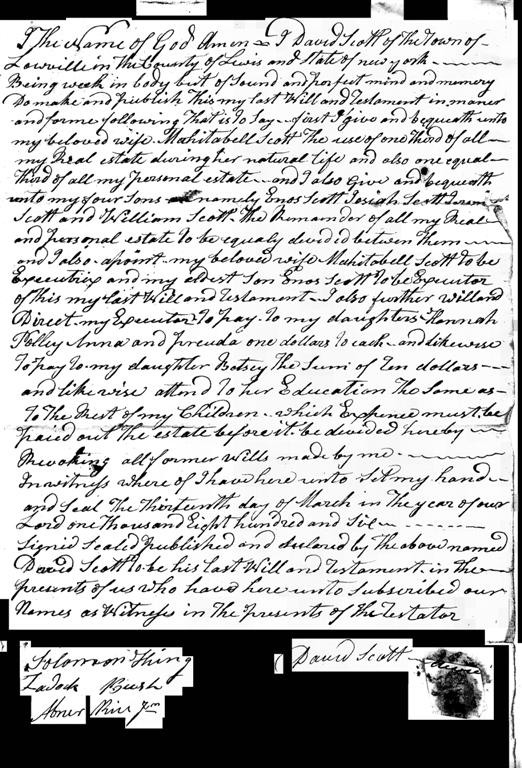
Years later, Mark Webb and his father, Richard, traveled through New York and Ohio looking for family records. One of the discoveries they made together was David Scott’s 1806 will. It names a daughter Anna, but not her married name. That distinction is why the archive puts records alongside an account of what they can and cannot tell us. [4] [6]
Keeping the search going
Mark has also collected family stories and photographs on his mother’s Johnson side. The Webb archive carries on the work of sharing records, this time with scans, transcriptions, maps, and family accounts. One question remains open: Who were James Webb’s parents?
Sources
- Wilford J. Webb, The James & Anna Scott Webb Family, compiled July 1961, opening account of the 1951 Wisconsin visit and subsequent research.
- Donald D. Webb, The James Webb Family (1979), redacted reading copy, introduction and printed pp. 10–11 and 13–14, transcribed and annotated by Mark H. Webb. Includes Donald’s credits to Dorothy and Altha and the account of Carrie’s visit.
- Wilford J. Webb, June 1952 Jefferson County research memorandum, notes pp. 1–8, transcribed May 2004 by Mark H. Webb. Wilford’s later recollection and the field notes distinguish his first 1951 visit from later visits.
- Family recollections supplied by Mark Webb, for the round robin and the research trip; see also Ella’s biography.
- Mark Webb, Frank Jay Webb family group sheet, sources, crediting Ella’s 1968 Woodman tree.
- David Scott’s will, dated March 13, 1806, Lewis County Will Book A, p. 1. Recorded copy and transcription.
- Nancy Ellen Robinson, A Compilation of Information About the Life of Arvilla A. Hendrick (2005) and The Interesting Life of Mary Melissa (Hendrick) Hall (2006). See the source notes for Peter and Arvilla Hendrick and Nathaniel and Mary Hall.
- Nancy E. Robinson, David Woodman family compilation (1992) and Notes on the Life of Bertha (Woodman) Webb (2008), cited in the articles on Bertha Woodman Webb and Frank Jay Webb.
- Early Webb research appendix, adapted from Mark Webb’s legacy-site essays and notes. See the citations there for the account book and earlier research leads.